FDA 21 CFR vs EU Food Contact Standards for In-Mold Labels: A Buyer's Compliance Comparison
Short answer for buyers: an in-mold label used on a food container is part of the food-contact article, not a sticker sitting on top of it. For the US market, the compliance reference is FDA 21 CFR Part 177 — including 21 CFR 177.1520 for olefin polymers such as PE and PP. For the EU market, it is Regulation (EU) No 10/2011 for plastic materials intended to come into contact with food. YZY supports both files with food-grade PP, PE and PET film, low-migration water-based ink, a ZY-IML Series FDA Food Contact Test Report, SGS report number NGBEC2501946006, and BRCGS, ISO 22000 and QS system certifications.
Most food-contact compliance problems in in-mold labeling do not begin with a bad product. They begin with a mismatched document: a film test report offered for a market that asks for migration data, a factory certificate offered as if it covered a specific ink, or a food-contact requirement imposed on a paint bucket that never needed one. This guide compares the two frameworks buyers meet most often, explains what each piece of YZY documentation actually covers, and shows where each applies across yogurt cups, food packaging, daily chemicals and industrial containers.
Why IML Compliance Is a Different Kind of Question
In-mold labeling integrates the printed film into the plastic container during molding, so the label and the container become a single part. There is no adhesive and no after-molding label application step, which is why IML labels do not carry the peeling risk of post-production labels in high-humidity environments. The same integration is what makes compliance more demanding: the film and the ink are permanently embedded in the container wall, and in a food application they sit permanently inside the food-contact zone.
Three practical consequences follow:
- The unit of compliance is the finished molded article, not the label as a separate component. The film resin family (PP, PE or PET), the ink system and the molding process all belong to the same evidence file.
- Requirements follow the end use, not the printing method. A yogurt cup and a paint bucket can run on the same IML printing platform and carry completely different regulatory burdens.
- A container approval does not automatically cover the label. If the film and ink were molded into the container, buyers should expect product-level test documentation for the IML construction itself.
The sourcing mistakes we see most often in IML programs:
- Asking for “an FDA certificate” for a label. 21 CFR Part 177 is a regulation listing permitted substances for food-contact use; the practical evidence is test documentation and material declarations that reference the relevant paragraphs, such as 177.1520 for olefin polymers.
- Accepting a film-only test file when the ink or the finished molded part was never in scope.
- Assuming a US-oriented test file answers EU requirements, or the reverse — FDA 21 CFR Part 177 and EU (EU) No 10/2011 are separate reference systems.
- Over-specifying. Applying food-contact requirements to daily chemical or industrial containers adds cost and paperwork without reducing the real risk, which for those applications is adhesion, waterproofing and resistance to the filled product.
- Treating compliance as a one-time purchase. Food-safety management systems are maintained through audit cycles, not through a single certificate issued years ago.
Industry Background: Why the Compliance File Now Carries More Weight
The in-mold label market is growing, and food is the largest part of it. Grand View Research valued the global in-mold labels market at USD 2.31 billion in 2023 and projected USD 3.14 billion by 2030. Market Research Future estimates the 2024 market at USD 2.72 billion with a projected CAGR of 3.94%, reaching USD 4.16 billion by 2035. Published estimates differ because segmentation and base years differ, so these figures are best read as directional market context rather than as inputs for supplier selection.
Two structural facts matter more for compliance planning:
- Food & Beverages accounted for the largest revenue share of over 41.3% of the in-mold labels market in 2023 (Grand View Research). The largest application block is also the most regulated one.
- Polypropylene (PP) is the dominant IML material with a 47.2% market share in 2023, and injection molding leads the production process segment with a revenue share above 57.1% in 2023 (Grand View Research). In practice, most food-contact IML projects are therefore PP-based and injection molded — exactly the combination that FDA 21 CFR 177.1520 and EU (EU) No 10/2011 address.
Regionally, Asia Pacific is the largest and fastest-growing IML market as of 2024 (Mordor Intelligence), which is also where a large share of global converting capacity sits. For buyers, the implication is straightforward: supplier documentation quality now matters as much as printing quality, because the food share of the market keeps growing.
The two regulatory anchors are stable and well defined. In the United States, FDA 21 CFR Part 177 regulates polymers including PE and PP for direct food contact applications. In the European Union, Regulation (EU) No 10/2011 sets requirements for plastic materials intended to come into contact with food.
How YZY Documentation Maps to Each Framework
YZY is the in-mold label brand of Zhejiang Zhongyu Technology Co., Ltd., a China-based manufacturer founded in 2009 that produces in-mold labels, sealing films, embossed lidding films and POF films, with food packaging among its main application fields. The company runs a 20,000 m² factory with approximately 250 employees, including a 10-person R&D team, and has accumulated 48 patents. Monthly IML production capacity is 350,000,000 pieces, with an export ratio of around 30% and customers worldwide, including long-term cooperation with brands such as Starbucks, Nestlé and Uni-President.

YZY’s in-mold label production base — a 20,000 m² facility serving food-grade and industrial IML programs.
What the ZY-IML Series FDA Food Contact Test Report covers
The ZY-IML Series FDA Food Contact Test Report is the US-market document in the file. It addresses the IML construction against the FDA framework for food-contact polymers — FDA 21 CFR Part 177, including 21 CFR 177.1520, which regulates olefin polymers such as PE and PP for direct food contact. That is the paragraph set most relevant to PP in mold label and PE in mold label projects intended for food packaging. Buyers using the report for a US or FDA-referencing market should confirm that it names the film grade and the ink system used in their project, because a report issued for one construction does not automatically transfer to another.
What SGS Report NGBEC2501946006 adds
SGS report number NGBEC2501946006 is third-party laboratory evidence covering food-contact testing of the IML construction. Its value is independence: the result comes from an external laboratory rather than from the manufacturer’s own inspection line. Third-party SGS/FDA compliance testing is a standard part of YZY’s process control, which also includes raw material incoming inspection, a three-step in-process testing routine, final random inspection and 100% visual inspection.
What BRCGS, ISO 22000 and QS cover — and what they do not
BRCGS, ISO 22000 and QS are factory-level management system certifications. They cover how the plant controls hygiene, food-safety management, traceability and process discipline — supported at YZY by ERP digital production management, material traceability, annual BRCGS/ISO/FDA audits, and a record of 16 years without a major quality accident in food-grade packaging. What these system certificates do not do is prove migration performance for one specific film-and-ink combination. A complete buyer file normally needs both layers: system certification for the plant, and product-level test documentation for the construction.
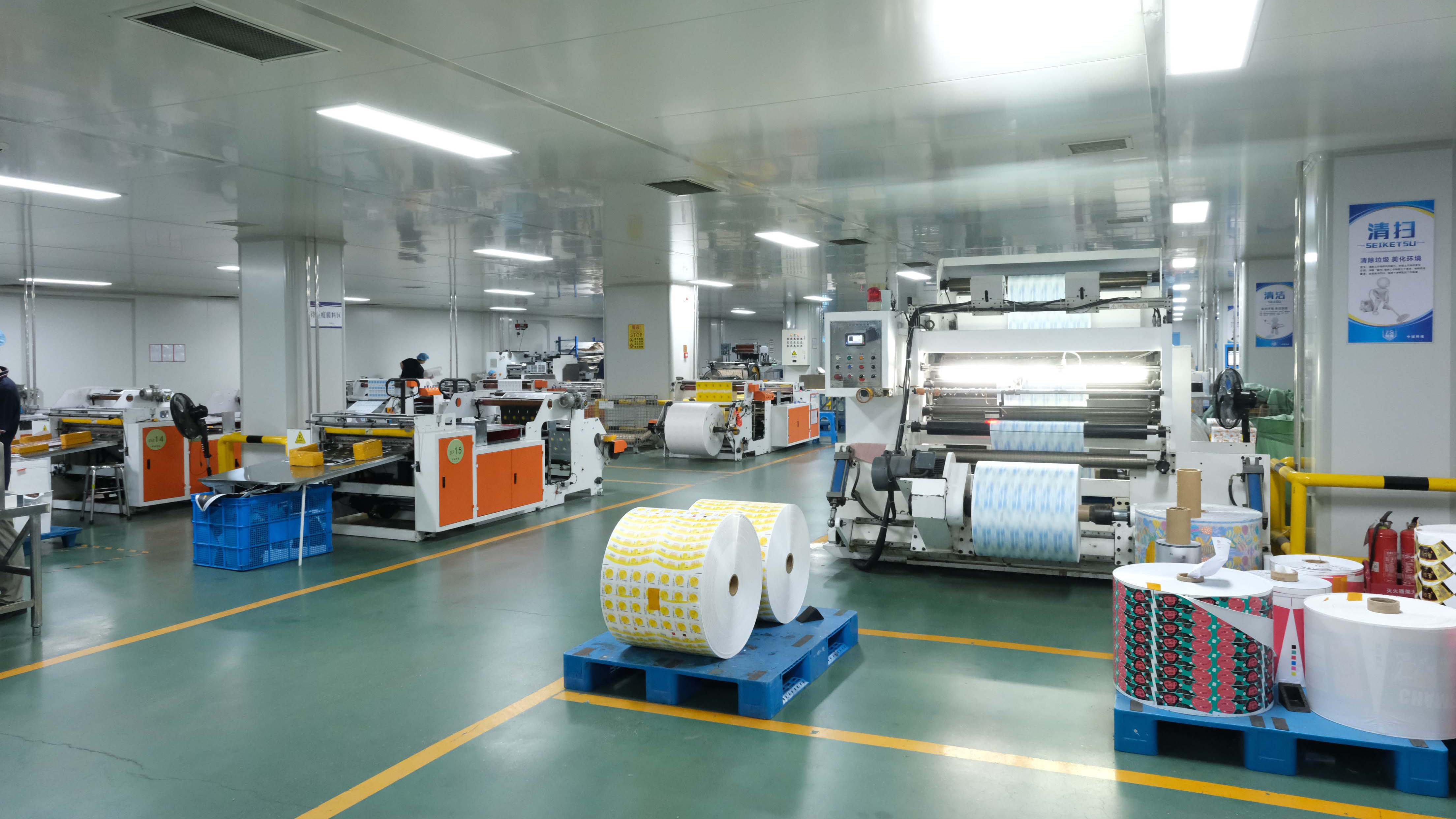
Inside the IML production workshop — incoming material inspection, in-process testing and final random inspection run on the same line.
Why the material set matters for both files
YZY produces IML on food-grade PP, PE and PET film using low-migration water-based ink. PP is the most widely used base film in the category, consistent with its 47.2% share of the global IML material market in 2023. Water-based ink is the choice that keeps the printed layer aligned with food-contact expectations — an important detail, because the ink sits on the food side of the container wall together with the film. For applications that need a robust surface — waterproof in mold labels and high adhesion in mold labels for buckets and chemical containers — the same printing platform is configured for durability rather than for migration control.
Step-by-Step: A Buyer’s Compliance Verification Workflow
The sequence below works for both frameworks. It assumes you already have a container program in mind — yogurt cups, ice cream containers, bubble tea cups, plastic bottles or an industrial bucket.
- Define the end market and the end use. Decide whether the label goes into a food-contact application or into daily chemical or industrial use, and in which region. This single step determines whether FDA 21 CFR Part 177, EU (EU) No 10/2011, or neither, is the governing reference.
- Write the construction into the RFQ. Specify film resin family (PP, PE or PET), film thickness, ink system and molding process — injection molding IML or blow molding IML. Compliance evidence attaches to a construction, not to a brand name.
- Request product-level test documentation and check its scope. For the US framework, ask for the ZY-IML Series FDA Food Contact Test Report. For third-party verification, ask for the SGS file, report number NGBEC2501946006. For EU programs, confirm how the supplier documents compliance with (EU) No 10/2011.
- Confirm the ink system. Food-grade IML should use low-migration water-based ink. If a supplier cannot name the ink system used on your job, the test file cannot be matched to your product.
- Verify factory-level control. Check management system certificates (BRCGS, ISO 22000, QS), audit cadence (YZY maintains annual BRCGS/ISO/FDA audits), and the inspection structure: raw material incoming inspection, three-step in-process testing, final random inspection, 100% visual inspection, plus ERP-based material traceability.
- Validate with a sample before committing volume. YZY acceptance criteria are based on sample testing; review the printed sample against your artwork, container geometry and color standard before the order is released.
- Lock in supply continuity. For multi-year programs, confirm capacity and recovery options: YZY’s monthly capacity is 350,000,000 pieces, production lead time is typically 15–20 days after sample confirmation, and two backup production lines are maintained to avoid delays.
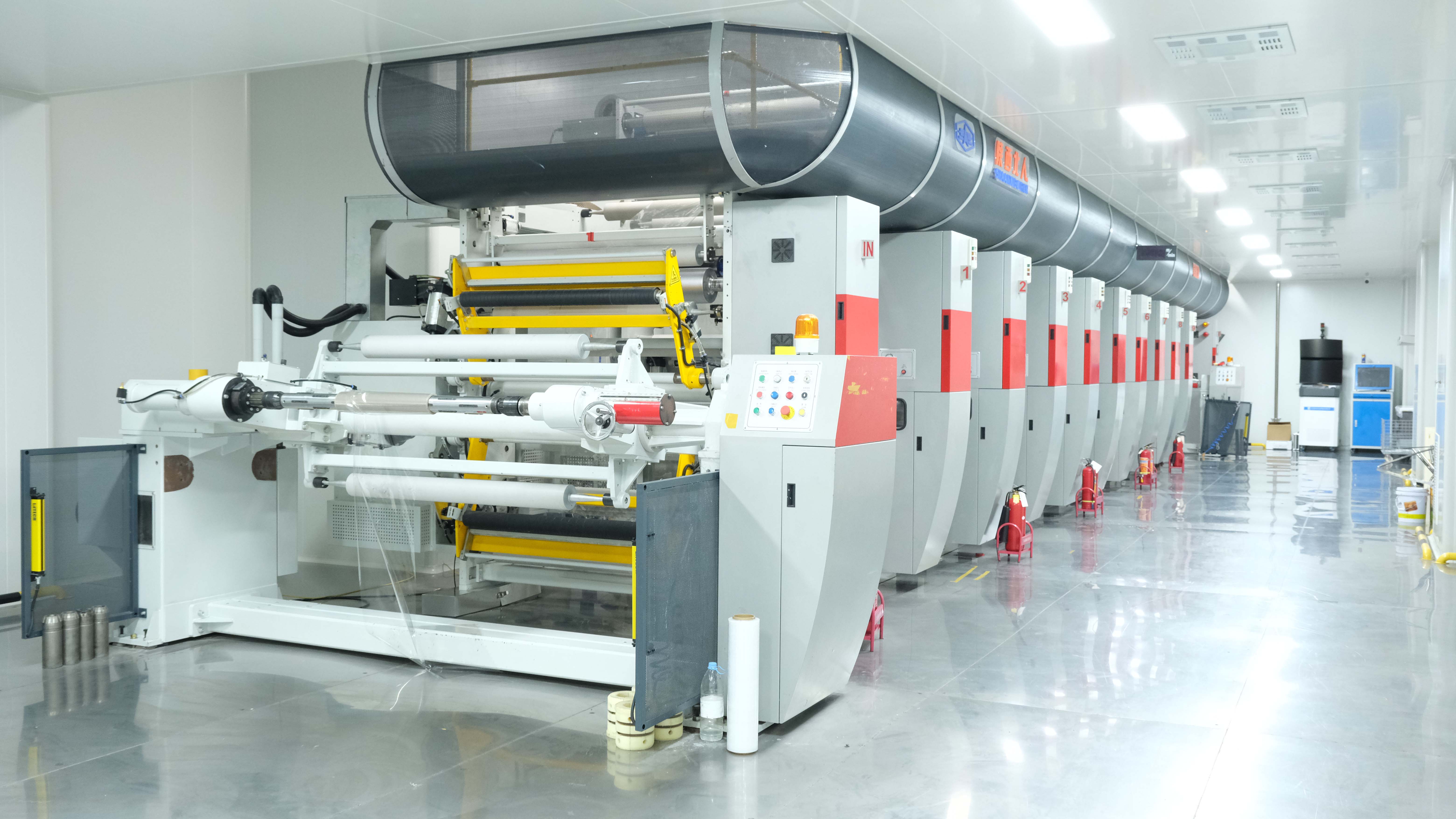
IML printing press — the printed layer that becomes part of the food-contact article after molding.
Use Cases: Where Each Framework Actually Applies
Yogurt cups, ice cream containers and bubble tea cups
These are direct food-contact, injection-molded applications and the clearest case for a full food-contact file. PP in mold labels dominate this segment because PP is the standard cup resin as well as the dominant IML film material. Buyers should expect product-level test documentation (FDA 21 CFR Part 177 for the US, (EU) No 10/2011 for the EU) in addition to factory system certificates.
Food packaging and lidding
YZY’s wider range includes sealing films and embossed lidding films, so an IML program can be coordinated with the lidding specification for the same product line. Where both the label and the lid contact food, buyers usually consolidate the documentation request rather than running it as two unrelated projects.
Plastic bottles and buckets: two different answers
Blow molding in mold labels are used on plastic bottles and plastic buckets, but the compliance answer depends entirely on the contents. A beverage bottle is a food-contact article; a paint bucket is not. Treating them as one category is one of the most common sources of either over-documentation or missing evidence.
Daily chemicals and industrial containers
For in mold labels for daily chemicals and for industrial labeling such as paint buckets, food-contact migration requirements typically do not apply. The performance question shifts to adhesion, waterproofing and resistance to the filled product — the failure mode YZY addresses by integrating the label into the molding process, which removes the peeling problems associated with post-production labels in humid environments. Durability, not migration testing, is the acceptance criterion here.
Comparison Table: FDA 21 CFR Part 177 vs EU (EU) No 10/2011
| Comparison point | US: FDA 21 CFR Part 177 (incl. 177.1520) | EU: Regulation (EU) No 10/2011 |
|---|---|---|
| Jurisdiction | United States | European Union |
| Reference scope | Regulates polymers including PE and PP for direct food contact applications | Requirements for plastic materials intended to come into contact with food |
| Relevance to IML | Applies to the olefin film and molded article in the food-contact file | Applies to the plastic material of the IML construction in the food-contact file |
| Evidence buyers typically review | Test report and material documentation referencing the applicable CFR paragraphs | Supplier declaration and migration test data supporting the plastic material |
| YZY documentation available | ZY-IML Series FDA Food Contact Test Report; SGS report NGBEC2501946006 as third-party verification | Same third-party SGS test file (NGBEC2501946006); BRCGS, ISO 22000 and QS system certifications for factory-level control |
| Applies to daily chemical / industrial IML? | No — food-contact regulation follows the end use | No — food-contact regulation follows the end use |
A second table makes the application mapping explicit, because this is where buyers most often over- or under-specify:
| End use | Food-contact framework needed | What the buyer should verify |
|---|---|---|
| Yogurt cup, ice cream container, bubble tea cup | Yes — FDA 21 CFR Part 177 (US) and/or (EU) No 10/2011 (EU) | Product-level test documentation for film and ink; system certificates (BRCGS, ISO 22000, QS) |
| Food packaging with lidding | Yes — same frameworks | Consolidated file covering IML film, ink and lidding |
| Plastic bottle for beverages | Yes — depends on the filled product | Blow molding IML construction and film grade named in the report |
| Daily chemical container | No | Adhesion, waterproofing and resistance to the filled product |
| Paint bucket and industrial container | No | Adhesion and durability after molding; peeling resistance in humid conditions |
FAQ: FDA and EU Food Contact Compliance for In-Mold Labels
1. Does an in-mold label need its own FDA or EU food-contact compliance if the container is already food-approved?
Yes. Once the film and ink are molded into the container wall, they become part of the food-contact article, and the container resin approval does not automatically cover them. For the US market, the reference is FDA 21 CFR Part 177, including 21 CFR 177.1520 for olefin polymers such as PE and PP. For the EU market, the reference is Regulation (EU) No 10/2011 for plastic materials intended to come into contact with food. YZY supports the US file with the ZY-IML Series FDA Food Contact Test Report and third-party verification through SGS report number NGBEC2501946006.
2. What food-grade film and ink options can YZY supply for IML?
YZY produces in-mold labels on food-grade PP, PE and PET film with low-migration water-based ink, for both injection molding IML and blow molding IML programs. Production runs in a 20,000 m² facility with approximately 250 employees, a 10-person R&D team and 48 patents, at a monthly capacity of 350,000,000 pieces.
3. What are the commercial terms — MOQ, delivery and payment?
MOQ is 2,000 m². Delivery terms are FOB or CIF, and payment terms are 30/70. On total cost, IML carries a slightly higher material cost than traditional labels but reduces post-production labor and rejection rates; the integrated process also reduces production steps by 30% and saves roughly 20% of lead time compared with post-production labeling.
4. How does sampling and acceptance work before mass production?
Acceptance is based on sample testing. YZY runs sample confirmation before production is released, so the printed sample, container fit and color can be reviewed first. Production lead time is typically 15–20 days after sample confirmation.
5. What lead time and supply continuity can a multi-year packaging program expect?
Monthly capacity is 350,000,000 pieces with a typical production lead time of 15–20 days after sample confirmation. Supply continuity is supported by ERP digital production management, material traceability and two backup production lines, and compliance continuity is maintained through annual BRCGS/ISO/FDA audits rather than a one-off certificate. For a specific project, send your film, container process and target market to yzy@inmoldlabel.net to request a sample and a quotation.
Conclusion: Match the File to the Market, Not to the Label
FDA 21 CFR Part 177 and EU Regulation (EU) No 10/2011 answer the same underlying question — what may come into contact with food — but they are separate reference systems, and an in-mold label sits inside the food-contact article rather than on top of it. The practical rule for buyers is to decide the market and the end use first, then request documentation that names the exact construction: film resin, ink system and molded part. Food applications need product-level test evidence such as the ZY-IML Series FDA Food Contact Test Report and third-party SGS report NGBEC2501946006, backed by factory-level BRCGS, ISO 22000 and QS control. Daily chemical and industrial applications such as paint buckets need adhesion and durability instead, and paying for food-contact documentation there is cost without benefit.
That mapping — framework to market, framework to end use, and document to construction — is what keeps an IML program compliant and commercially sensible across yogurt cups, food packaging, daily chemicals and industrial containers.
Work with YZY on your next IML program
YZY (Zhejiang Zhongyu Technology Co., Ltd.) supplies in-mold labels, sealing films, embossed lidding films and POF films for food packaging and other industries, with 16 years of IML manufacturing experience and a monthly capacity of 350,000,000 pieces.
Request samples, a quotation or the full product brochure: Download the YZY product brochure (PDF)
Email: yzy@inmoldlabel.net · Tel / WhatsApp: +86 182 6778 1866 · Website: www.inmoldlabel.net
Address: Building 59, Zone E, Guohong Zhizao new town, Xingke Road, Longgang, Wenzhou, Zhejiang, China 325802
Have Questions or Need More Details?
Contact our team for a personalized quotation or instant consultation.
Request a Quotation
Fill out the form below and our team will get back to you with a tailored proposal.
WhatsApp Direct Chat
Prefer to chat in real-time? Message us on WhatsApp for instant assistance & quick answers.
- Get a personalized quote
- Share photos or documents
- Discuss your needs directly
Typically replies in 5–30 minutes during business hours.