IML Surface Finishes Compared: Glossy, Matte, Orange Peel, and Holographic
In-mold labeling (IML) surface finish is fixed once and then repeated on every container that follows. Glossy, matte, orange peel, holographic and custom texture finishes are all produced on the same rotogravure printing platform, yet they behave differently inside the mold, during filling and on the shelf. This comparison sets the five finish families against the parameters that actually decide an order: film thickness, printing capability, adhesion strength, scratch resistance, temperature range and food-contact compliance.
Why the IML Surface Finish Decision Is a Constraint, Not a Design Preference
Most packaging buyers treat surface finish as a visual choice made late in the process. In IML it is an engineering constraint made early. Because the label is placed into the mold and fused to the container wall during injection, the finish has to survive the molding cycle before it ever reaches a filling line. A finish that looks right on a printed sample can still fail if it distorts under heat, loses adhesion at the flow front of the melt, or scuffs during handling.
Three consequences follow from that reality. First, changing a finish after tooling and print plates are approved usually means new film lamination and new print work, not a cosmetic adjustment. Second, the finish interacts with the substrate: polypropylene (PP) and polyethylene (PE) films bond differently, and a lamination that performs on one container wall may behave differently on a curved or thin-walled part. Third, the finish sits inside the food-contact envelope, so appearance decisions cannot be separated from migration and compliance questions.
For buyers in the Research and Evaluation stages, the practical framing is this: choose the finish from the container's real operating conditions first — filling temperature, cold chain exposure, abrasion during transport, cleaning chemicals — and only then confirm that the visual effect still delivers the brand look that motivated the conversation.
Industry Background: Where IML Finish Demand Is Growing
IML is not a niche decoration method. According to Grand View Research, the global in-mold labels market was valued at USD 2.31 billion in 2023 and is projected to reach USD 3.14 billion by 2030, a CAGR of 4.6%. Within that market, injection molding is the dominant production process, accounting for over 57.1% of market share in 2023, which is why finish durability under injection conditions matters more than finish appearance on a flat proof.
Material choice is concentrated. Polypropylene (PP) dominated the IML material segment with a 47.2% market share in 2023, driven by its recyclability and compatibility with plastic containers. Demand is also geographically concentrated: Dataintelo reports that Asia-Pacific led the IML market with a 42.8% revenue share in 2025, fueled by growth in the dairy and paint industries in China and India.
Food and beverage is the largest single application cluster. Grand View Research places food and beverage applications at over 41.3% of IML revenue share in 2023, with specific growth in yogurt cups and ice cream containers. On the film side, Future Market Insights projects the global in-mould label film market growing from USD 1.3 billion in 2025 to USD 1.7 billion by 2035 — a reminder that finish decisions sit on top of a film supply chain, not only a printing choice.
Two direction signals are worth noting for finish selection. IML technology is increasingly used in 20-litre paint pails to form a permanent bond resistant to solvent spills and moisture. At the same time, EU Regulation (EC) No 1935/2004 provides the framework for food contact materials and requires IML labels to ensure safety and prevent chemical migration into food — a rule that applies regardless of which decorative finish is chosen.
The Five IML Surface Finishes Explained
The ZY-IML Series from YZY (Zhejiang Zhongyu Technology Co., Ltd.) covers five finish families. Each one is built on a different film construction, and that construction — not the finish name alone — determines how the label behaves in production.
1. Glossy Finishes
Glossy is the highest-reflectivity option in the range and is produced on Complex White Gloss Film, Complex Transparent Gloss Film and Standard Gloss Film. The white gloss and transparent gloss variants differ in the same way they do in any label system: a white gloss base provides an opaque graphic field, while a clear gloss construction lets the container colour read through the printed area. Glossy finishes hold strong colour saturation, which is why they suit high-contrast brand graphics and industrial containers where scuff visibility is less of a concern than print impact.
The constraint to watch is reflectivity under artificial light and on curved walls. Gloss amplifies surface imperfections, so wall thickness variation and mould texture show through more readily than they do under a matte finish.
2. Matte Finishes
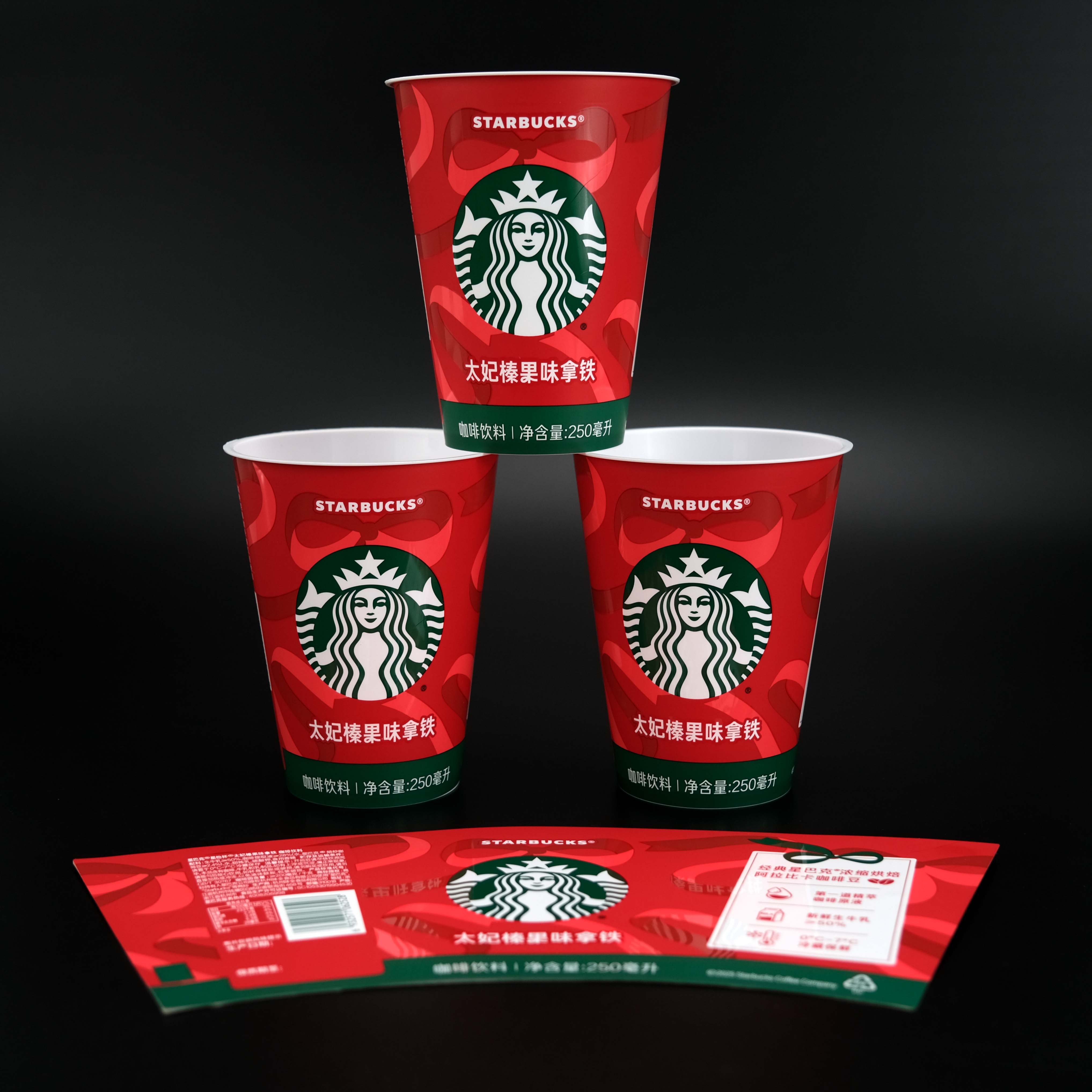
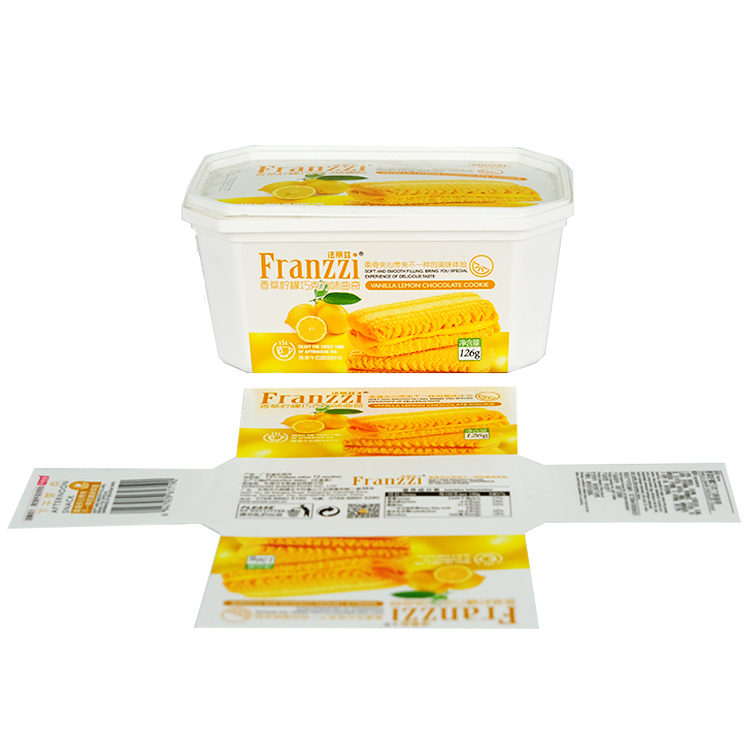
Matte Laminated Film produces the low-reflectivity finish used across much of the food and dairy segment. Matte reduces glare, softens the perceived surface and hides minor scuffs better than gloss. In dairy applications — yogurt cups and ice cream containers in particular — matte is often chosen because the finish reads as premium without depending on metallic or reflective effects, and because it does not fight the lighting in a chilled display case.
The constraint to watch is ink anchoring and scuff visibility in the opposite direction. Matte surfaces diffuse light, which means a deep scratch can appear as a light streak rather than a bright line. Scratch and abrasion behaviour should therefore be confirmed on finished, moulded parts rather than on flat printed film.
3. Orange Peel Finishes
Orange peel is a textured finish in the ZY-IML range, produced on textured matte laminated film. The fine, uniform grain breaks up reflected light and masks the small handling marks that accumulate on containers during filling, palletising and retail stocking. That makes orange peel a practical choice for industrial and household containers — paint buckets, lubricant buckets and utility pails — where the pack is handled repeatedly and where a uniform, non-reflective surface is preferred over a high-gloss appearance.
The constraint to watch is texture consistency from batch to batch, which is a lamination and mould-surfaces issue rather than a print issue. Adhesion at texture peaks also deserves attention: a textured surface presents a slightly different bonding profile than a flat one, so the ≥5N adhesion specification should be verified on the actual textured construction rather than assumed.
4. Holographic Finishes
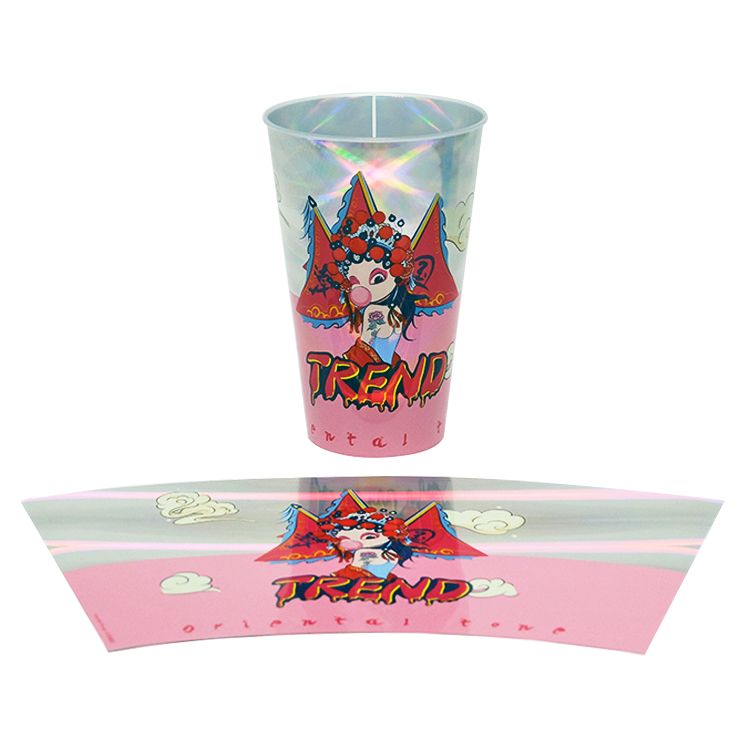
Holographic Film creates a light-shifting, reflective effect that changes as the container is rotated. It is used where the pack itself is part of the marketing message: premium beverages, promotional dairy lines, cosmetics and gift-oriented packaging. Holographic finishes are also a practical anti-counterfeit signal, because the effect is difficult to reproduce convincingly outside an IML process.
The constraint to watch is print contrast. Because the base film is already visually active, fine type and light-coloured graphics can lose legibility over the effect. Holographic constructions usually need the print artwork to be designed for the film, not adapted to it. Effect uniformity across a production run and adhesion of the holographic layer are the two items that should be confirmed at sample stage.
5. Custom Texture and Specialty Finishes
Beyond the four named finishes, the range supports custom texture and custom film formulation, including Metallic Film. Custom finishes are typically specified when a brand needs a tactile or visual signature that cannot be achieved with a standard gloss, matte, orange peel or holographic construction. Because they involve a new film formulation rather than a stock construction, custom textures should be treated as an engineering project: sample approval, repeatability confirmation and a realistic lead-time and minimum-order discussion all move earlier in the timeline.
Shared Technical Parameters Across All Finishes
Finish selection happens on top of a fixed technical platform. These parameters apply across the ZY-IML Series and define what the finish has to survive:
- Film thickness: 30μm to 100μm, customizable by application
- Printing technology: high-precision rotogravure printing with up to 8 colours
- Printing precision: ±0.1mm registration with no colour deviation
- Adhesion strength: ≥5N, with no peeling during injection molding
- Operating temperature range: −20°C to 120°C, covering cold chain and hot filling
- Tensile strength: ≥20MPa
- Scratch resistance: 4H by pencil hardness test
- Chemical resistance: resistant to weak acids, alkalis and common detergents
- Maximum printing width: 1200mm
- Ink system: food-grade low-migration water-based ink
- Film materials: food-grade virgin PP and PE resin, PET, and multi-layer composite laminated films
Two of these deserve emphasis for finish evaluation. The 4H pencil hardness figure is a product-level specification — a buyer should confirm it holds for the specific finish being ordered, because a textured matte and a high-gloss lamination do not present identical surfaces to an abrasion test. The −20°C to 120°C window is what allows the same finish family to serve a frozen dessert container and a hot-filled sauce or beverage application, but the finish must be validated at the temperature the line actually runs, not at the edge of the range.
Step-by-Step: Testing and Accepting an IML Finish Before Mass Production
The finish decision is only as good as the evidence behind it. Buyers evaluating IML finishes should run the following sequence before releasing a mass-production order.
- Write the finish specification in measurable terms. Name the finish family, the film construction, the film thickness within the 30–100μm window, the number of print colours (up to 8) and the maximum printing width needed. A finish described only as “matte” or “holographic” is not a specification.
- Request finish samples built on the real construction. A glossy label on a generic film does not prove a complex transparent gloss construction on a thin-walled yogurt cup. Ask for the sample to match the substrate, container geometry and finish combination actually intended.
- Check print quality against the ±0.1mm registration figure. Inspect fine type, barcode edges and multi-colour registration under magnification, and confirm that no colour deviation appears at the highest colour count used in the artwork.
- Verify adhesion after moulding, not before. The specification is ≥5N with no peeling during injection molding. The relevant test is on moulded parts taken from the actual tooling, including the corners and gate areas where melt flow stress is highest.
- Run the pencil hardness check for scratch resistance. Confirm 4H behaviour on the finished surface. This matters most for matte and orange peel finishes, where scratch appearance differs from gloss.
- Expose the sample to the real temperature cycle. Test at the highest filling temperature and the lowest cold-chain temperature the product will see within the −20°C to 120°C window. Watch for finish distortion, edge lifting or gloss change.
- Test chemical exposure where relevant. The range is resistant to weak acids, alkalis and common detergents. For paint buckets and lubricant containers, solvent and spill exposure should be part of the trial, consistent with the way IML is used on 20-litre paint pails to form a permanent bond resistant to solvent spills and moisture.
- Confirm the compliance file. For food-contact applications, verify the certification documentation against the finish and construction being ordered — not against a generic product certificate.
- Agree the acceptance inspection method. Production quality control for the range combines 100% visual inspection with random laboratory testing for FDA/GB compliance. Buyers should agree in advance what constitutes a visual reject and how random lab samples are drawn.
Application Fit: Yogurt Cups, Paint Buckets, Bubble Tea Cups and Ice Cream Containers
Finish selection becomes concrete only when it is tied to the container and the filling line.
Yogurt cups. Matte laminated film is the natural fit for the chilled dairy shelf, where glare reduction and a premium tactile read matter more than reflectivity. Adhesion and finish appearance should be validated on the actual cup wall thickness, and cold-chain performance verified within the −20°C to 120°C range.
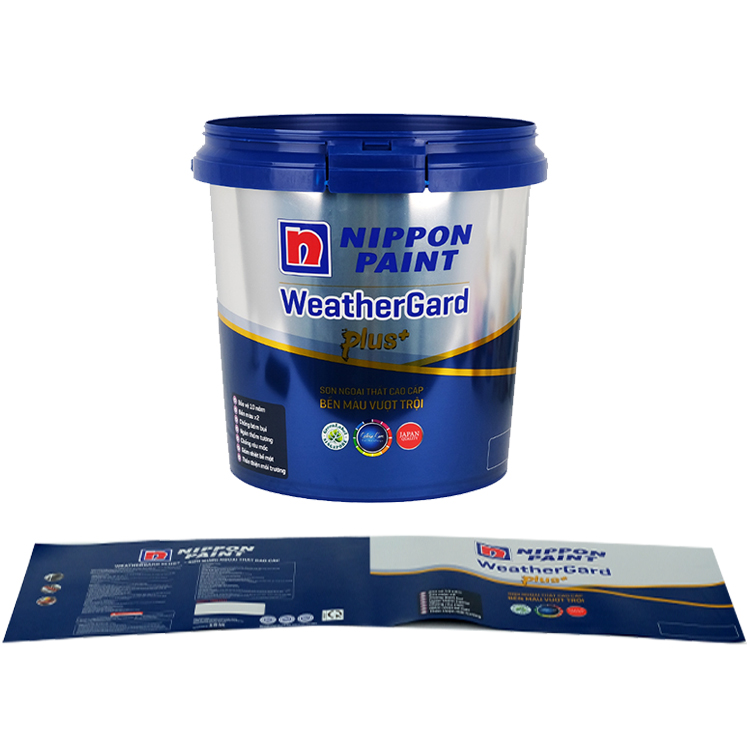
Paint buckets and lubricant buckets. Glossy finishes give the strongest colour impact on large-diameter industrial containers, while orange peel offers a more forgiving surface for packs handled on site. Either way, solvent and spill exposure is the decisive test, and chemical resistance to weak acids, alkalis and common detergents is the baseline to confirm.
Bubble tea cups and clear beverage cups. Complex transparent gloss film lets the container remain visually transparent while carrying branding, which is why clear gloss constructions are frequently specified here. Print registration at ±0.1mm becomes critical because small type is often printed over a clear field.
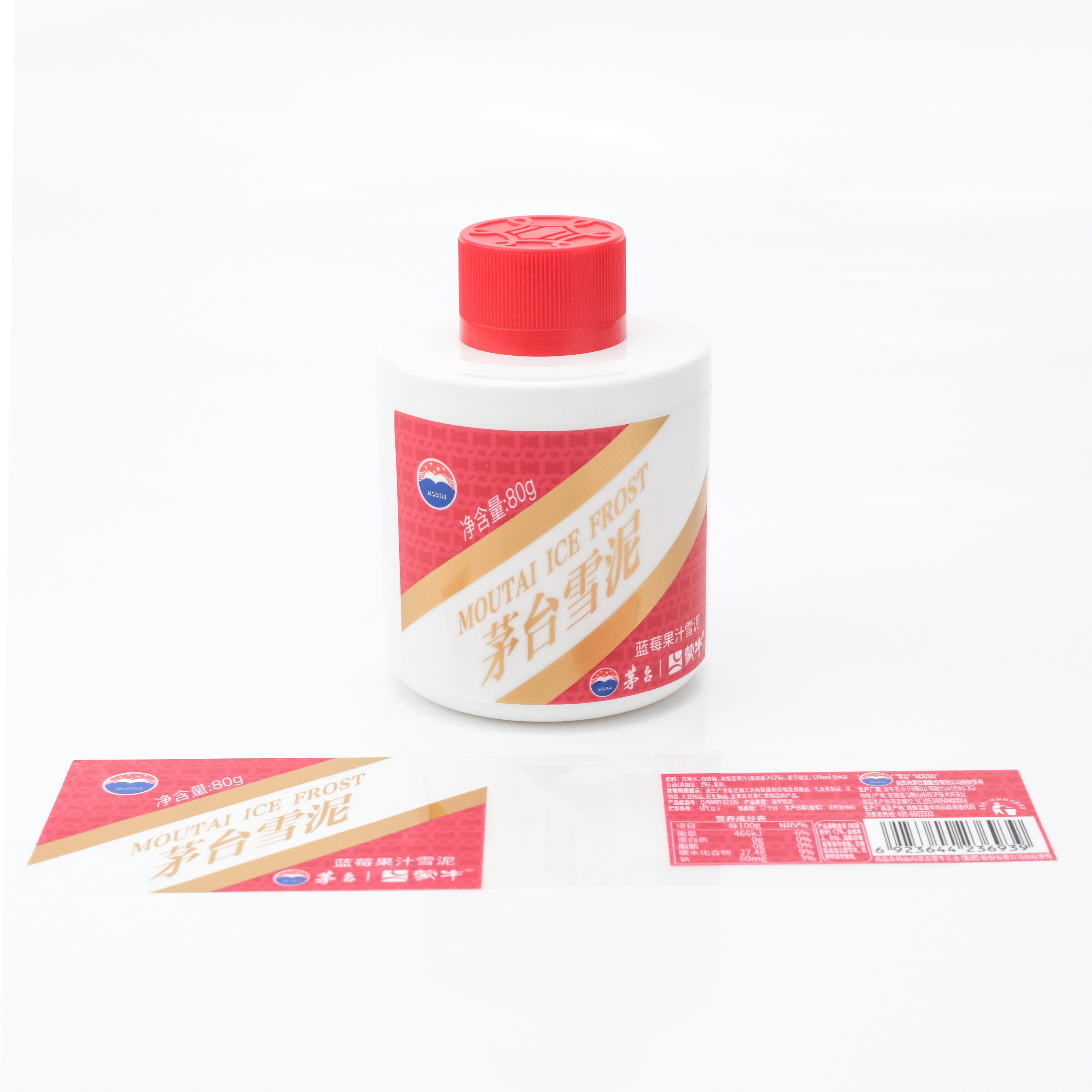
Ice cream containers. Matte and holographic finishes both appear in this segment for different reasons — matte for a clean, premium dairy look, holographic for promotional and limited-edition lines. Low-temperature storage and condensation are the performance considerations to test.
Daily chemical and cosmetic containers. Shampoo, detergent and cosmetic packs frequently use holographic or custom texture finishes where shelf differentiation drives the decision. Migration and food-contact rules do not apply in the same way as for food, but print durability and chemical resistance still govern finish choice.
IML Surface Finish Comparison Table
The table below compares the five finish families on the criteria that determine fit. All film constructions listed are part of the ZY-IML Series; shared mechanical parameters apply across the range as described above.
| Finish | Film construction in the ZY-IML range | Visual character | Typical application fit | Primary verification focus |
|---|---|---|---|---|
| Glossy | Complex White Gloss Film, Complex Transparent Gloss Film, Standard Gloss Film | High reflectivity, strong colour saturation | Paint and lubricant buckets, clear beverage and bubble tea cups, detergent containers | Adhesion after moulding, ±0.1mm registration, chemical resistance |
| Matte | Matte Laminated Film | Low reflectivity, soft-touch appearance, reduced glare | Yogurt cups, ice cream containers, premium dairy, daily chemical packs | Scratch appearance, ink anchoring, texture uniformity |
| Orange Peel | Textured matte laminated film | Fine uniform grain that diffuses light and masks handling marks | Industrial buckets, household and utility containers, frequently handled pails | Batch-to-batch texture consistency, adhesion at texture peaks |
| Holographic | Holographic Film | Reflective, light-shifting effect that changes with viewing angle | Premium beverages, promotional dairy, cosmetics, gift packaging | Effect uniformity, adhesion of the holographic layer, print contrast |
| Custom Texture | Custom film formulation (Metallic Film also available in range) | Brand-specific tactile or visual signature | Brand-differentiated food, daily chemical and cosmetic packaging | Sample approval, repeatability, MOQ and lead-time impact |
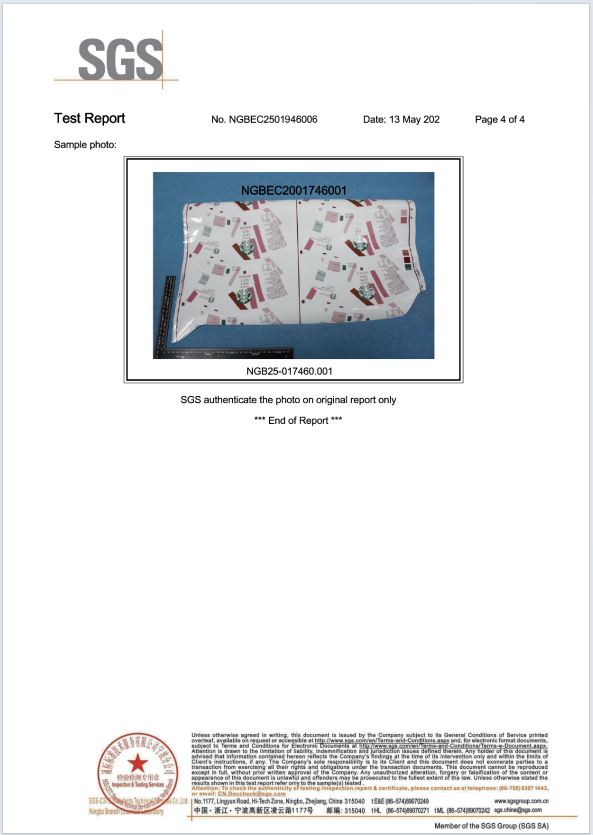
One structural point sits underneath the table: whichever finish is chosen, the label construction must also satisfy the compliance requirement for its end use. For food-contact applications in the US and North America market, the IML product is certified to FDA 21 CFR 177.1520 for food contact, certified by SGS under certificate number NGBEC2501946006. The migration test meets EU 10/2011 food contact material standards, and the compliance framework includes BRCGS, ISO22000 and QS certification. YZY holds QS, ISO and BRC management system certifications and a total of 48 patents.
What this means for a buyer: finish and compliance are two separate approvals. Passing the migration requirement does not automatically validate a new textured or holographic lamination, and passing an adhesion test does not validate the compliance file. Both should be signed off against the exact construction being ordered.
Frequently Asked Questions
Do all IML surface finishes meet food-contact requirements?
Food-contact compliance is granted to the label construction, not to a finish name in isolation. The IML product is certified to FDA 21 CFR 177.1520 for food contact, issued by SGS under certificate number NGBEC2501946006 for the US and North America market, and its migration test meets EU 10/2011 food contact material standards. Compliance standards for the range also include BRCGS, ISO22000 and QS, and the company holds QS, ISO and BRC management system certifications. Buyers ordering a glossy, matte, orange peel, holographic or custom texture finish should still verify that the specific film and lamination combination they receive is covered by the certificate file, since the underlying film construction changes between finishes. In the EU, Regulation (EC) No 1935/2004 sets the framework requiring IML labels to prevent chemical migration into food.
Can one IML supplier deliver glossy, matte, orange peel and holographic finishes on the same program?
Yes. The ZY-IML Series covers glossy, matte, orange peel, holographic and custom texture finishes on a single technical platform: film thickness 30μm to 100μm, high-precision rotogravure printing up to 8 colours, printing precision of ±0.1mm, maximum printing width 1200mm, adhesion strength ≥5N with no peeling during injection molding, tensile strength ≥20MPa, scratch resistance 4H by pencil hardness test, and an operating temperature range of −20°C to 120°C. OEM and ODM customization covers size, shape, colour, printing design and material. YZY produces in-mold labeling with 16 years of manufacturing experience at a 20,000 m² facility with 250 employees and a monthly capacity of 350,000,000 pieces. Finish changes within a running program still require sample re-approval, because each finish uses a different film construction.
What drives the cost difference between IML surface finishes?
Four variables account for most of the gap. The first is film construction: a standard gloss film, a matte laminated film, a textured matte film and a holographic film are different input materials. The second is printing complexity — the platform supports up to 8 colours, and artwork that uses more colours across more stations adds cost, as does the tighter registration discipline that fine graphics require. The third is whether the finish needs a custom film formulation rather than a stock construction; custom texture falls into this category. The fourth is order scale, since the minimum order quantity for the range is 2,000㎡ and finish-level setup cost is spread across that quantity. Buyers should request a finish-specific quotation rather than comparing finishes on a unit-price assumption, and should confirm MOQ and lead time together with the finish specification.
How do buyers test finish durability and print quality before committing to an order?
The sample stage is where finish risk is retired. Request samples built on the actual film construction and container geometry, then verify five things on moulded parts rather than flat film: adhesion at ≥5N with no peeling during injection molding; scratch resistance at 4H using the pencil hardness test; print registration at ±0.1mm with no colour deviation across the full colour count; finish behaviour at the real filling and cold-chain temperatures inside the −20°C to 120°C range; and chemical resistance to weak acids, alkalis and common detergents for containers exposed to spills or cleaning. For transparent gloss finishes used on clear cups, check fine type legibility over the clear field. For textured and holographic finishes, check that the effect is uniform across the sample area and that adhesion holds at texture peaks. Sample confirmation is also the trigger point for the production lead time.
What is the lead time for a custom finished IML order, and how is quality accepted?
Production lead time for the ZY-IML Series is 15–20 days after sample confirmation, with a minimum order quantity of 2,000㎡. Quality control combines 100% visual inspection with random laboratory testing for FDA and GB compliance, so buyers should agree the visual reject criteria and the random sampling method before production starts — these belong in the purchase specification alongside the finish definition. YZY exports to the EU, US, Middle East and Southeast Asia, and provides online technical support, after-sales consultation and quality complaint handling. For a finish-specific discussion on glossy, matte, orange peel, holographic or custom texture labels, contact Holly at yzy@inmoldlabel.net or via WhatsApp at +86 182 6778 1866 to request finish samples and a project quotation.
Conclusion
Glossy, matte, orange peel, holographic and custom texture finishes are not interchangeable aesthetic options — they are different film constructions running on one technical platform, and each one places a different load on adhesion, abrasion, temperature and print registration. Glossy and clear gloss maximise colour impact for paint buckets and clear beverage cups. Matte serves chilled dairy and premium daily chemical packs. Orange peel trades reflectivity for handling-mark tolerance on industrial containers. Holographic and custom textures buy shelf differentiation at the cost of tighter artwork design and longer sample validation.
The decision framework that holds across all five is straightforward: define the finish in measurable terms, select the container and filling conditions first, test adhesion, scratch resistance, registration and temperature on moulded parts rather than flat proofs, and confirm the compliance file against the exact construction being ordered. Buyers who run that sequence before releasing tooling avoid the most expensive IML mistake — discovering a finish problem after the plates are cut.
Next Step: Validate Your Finish Before You Commit
YZY (Zhejiang Zhongyu Technology Co., Ltd.) produces food-grade, daily chemical and industrial IML labels across glossy, matte, orange peel, holographic and custom texture finishes, with FDA food-contact certification under SGS certificate NGBEC2501946006 and QS, ISO and BRC management system certifications.
Request finish samples matched to your container and substrate, or download the full product catalogue here: YZY IML Product Catalogue (PDF). More technical references are available at www.inmoldlabel.net.
Email: yzy@inmoldlabel.net | Tel / WhatsApp: +86 182 6778 1866
Structured Data
Have Questions or Need More Details?
Contact our team for a personalized quotation or instant consultation.
Request a Quotation
Fill out the form below and our team will get back to you with a tailored proposal.
WhatsApp Direct Chat
Prefer to chat in real-time? Message us on WhatsApp for instant assistance & quick answers.
- Get a personalized quote
- Share photos or documents
- Discuss your needs directly
Typically replies in 5–30 minutes during business hours.