In-Mold Label Technical Guide: Film Thickness, Adhesion, and Temperature Parameters
Answer first: an in-mold label (IML) lives or dies on three measurable specifications — film thickness, adhesion strength, and temperature resistance. The ZY-IML Series is specified at a film thickness of 30μm to 100μm (customizable), an adhesion strength of ≥5N with no peeling during injection molding, and an operating temperature range of -20°C to 120°C. Those three values are supported by a maximum printing width of 1200mm (customizable), 8-color high-precision rotogravure printing at ±0.1mm precision, a tensile strength of ≥20MPa, and 4H scratch resistance measured by pencil hardness test.
YZY (Zhejiang Zhongyu Technology Co., Ltd.) is an in-mold labeling manufacturer founded in 2009, operating a 20,000 m² facility with 250 employees and a 10-person R&D team. The company produces the ZY-IML Series in food grade, daily chemical grade, and industrial grade, and also supplies sealing films, embossed sheet sealing lids, and POF films. This guide explains what each parameter actually controls inside a mold, and how to match film specifications to PP, PE, and PET container materials.
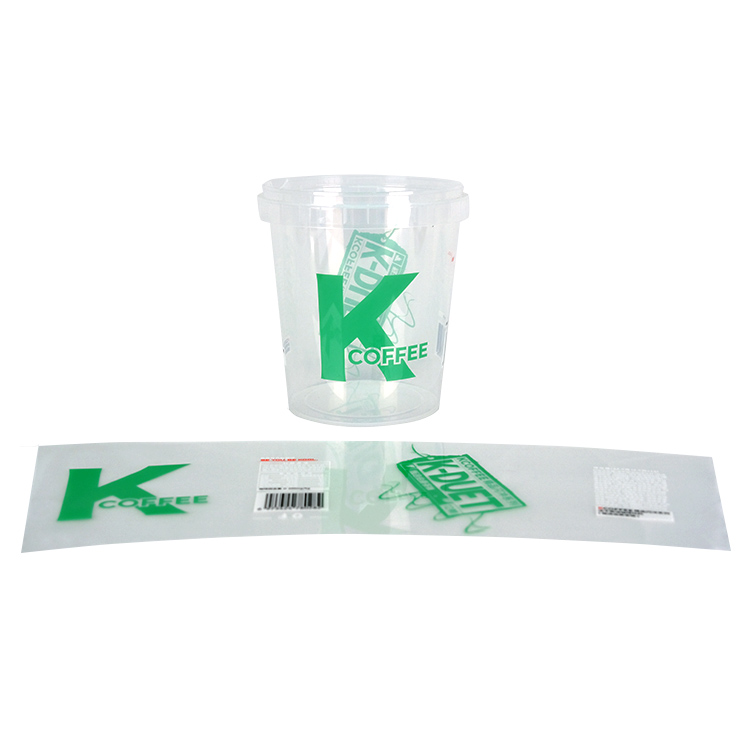
Clear glossy laminated film — one of the base films used in the ZY-IML Series.
Why IML Specifications Decide Whether a Container Project Succeeds
An in-mold label is not applied after molding. It is placed inside the mold cavity and bonded to the container wall by the heat and pressure of the injected resin, which means the label becomes part of the container itself. Every specification therefore has to survive the molding cycle, not merely look correct on a printed roll.
Three failure mechanisms account for most IML problems:
- Adhesion failure. When the film-to-resin bond is weaker than the forces acting on the container wall, the label lifts at the edges or peels in service. The ZY-IML Series specifies adhesion strength of ≥5N with no peeling during injection molding. That figure is a minimum requirement, not an average of good and bad runs.
- Thermal mismatch. Containers move between cold chain and hot filling. A film that is stable at room temperature but not across the full -20°C to 120°C window can wrinkle, curl, or lose registration after filling.
- Dimensional and colour drift. Registration around a curved container is unforgiving. Printing precision of ±0.1mm keeps multi-colour artwork aligned after the film has been formed into a three-dimensional shape.
Secondary parameters protect the same outcome. Tensile strength of ≥20MPa governs how the film behaves during cutting and high-speed label placement. Scratch resistance of 4H protects print integrity during stacking, palletizing, and transport. Chemical resistance to weak acids, alkalis, and common detergents matters whenever the container carries paint, lubricants, or household cleaning products.
The commercial argument for getting these three numbers right is simple: an IML label is molded into the container, so a specification error is discovered at the injection machine, not at the labelling station. By then the container, the resin, and the printed film have all been consumed together.
Industry Background: Where IML Sits in Packaging & Printing
In-mold labeling is a mature but still expanding segment of the Packaging & Printing industry. Grand View Research values the global in-mold labels market at USD 2.31 billion in 2023, projected to reach USD 3.14 billion by 2030. Market Research Future publishes a different estimate — USD 2.72 billion in 2024, with a projected CAGR of 3.94% reaching USD 4.16 billion by 2035. The two figures differ because the studies use different segmentation and base-year definitions, which is normal for this category; the direction of growth is consistent in both.
Application data explains why scenario matching matters more than generic brand preference. Grand View Research reports that the Food & Beverages segment accounted for the largest revenue share of over 41.3% of the in-mold labels market in 2023, and that polypropylene (PP) holds a 47.2% market share as the dominant film material. Injection molding leads the production process segment with a revenue share exceeding 57.1% in the same year. Mordor Intelligence identifies Asia Pacific as both the largest and the fastest-growing regional market as of 2024.
Regulatory context shapes the food-contact side of the category. Food-grade in-mold labels must comply with EU Regulation (EU) No 10/2011 for plastic materials intended to come into contact with food. In the United States, FDA 21 CFR Part 177 regulates polymers including PE and PP for direct food contact applications. Major global competitors in the sector include CCL Industries, Multi-Color Corporation, and Huhtamaki.
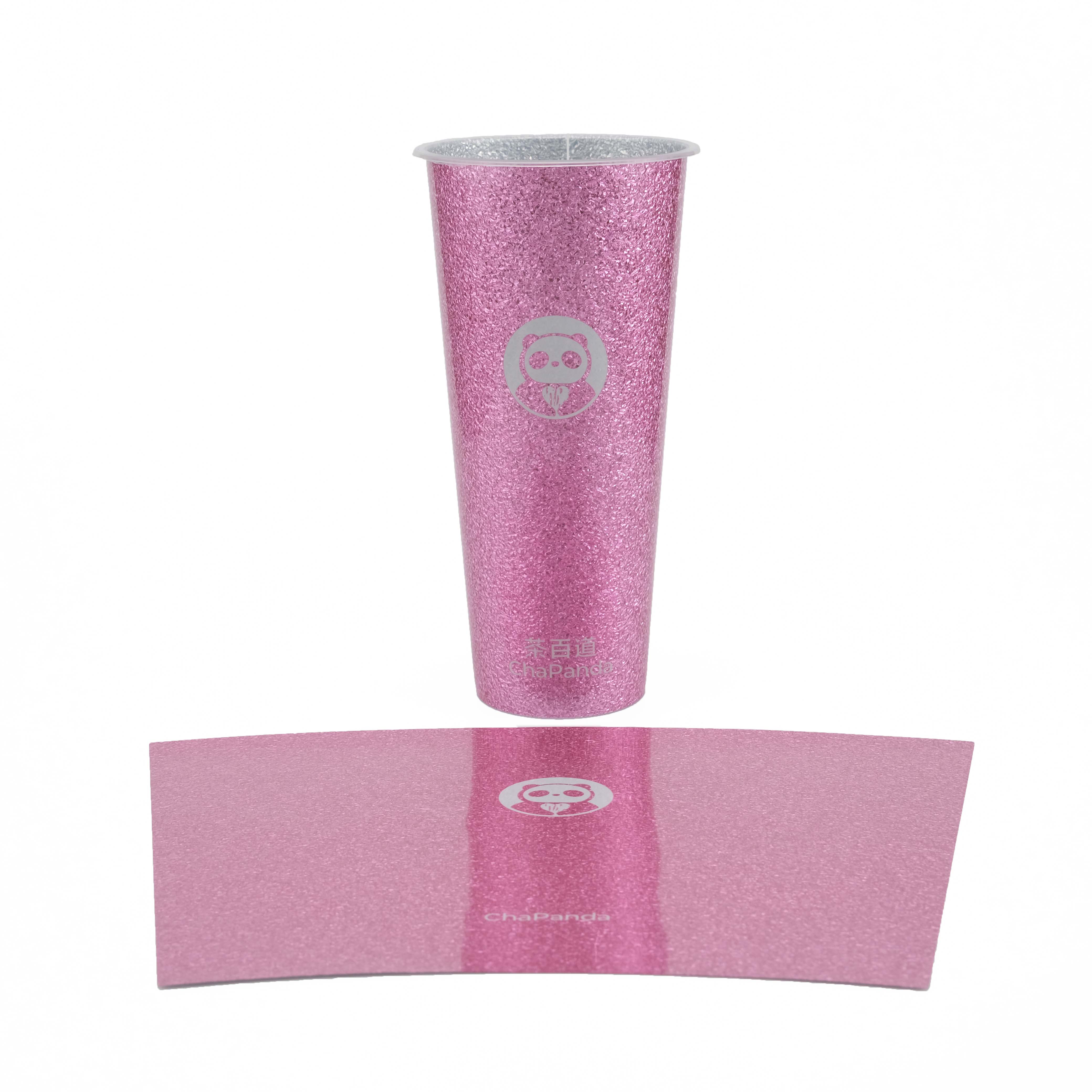
Complex white gloss film — the most widely specified base film for opaque food and dairy branding.
The Three Core Parameters Explained
Film Thickness: 30μm to 100μm (Customizable)
Film thickness is the first decision because it changes how the label behaves both before and inside the mold. The ZY-IML Series covers 30μm to 100μm, and the value is customizable per project. Thinner films generally conform more easily to tight radii and complex container geometry, while thicker films provide more body for opacity and for automatic label insertion equipment. The practical rule is to choose the thinnest film that still satisfies opacity, handling, and mold-placement requirements, because excess thickness adds material cost without adding performance.
Adhesion Strength: ≥5N With No Peeling
Adhesion strength is the parameter most likely to be questioned after a failed production run. In the ZY-IML Series the value is specified at ≥5N, with the stated behaviour being no peeling during injection molding. Buyers evaluating an IML supplier should ask two questions: which test method produced the adhesion figure, and whether that figure was verified on the same resin the container will actually use. Adhesion is a property of the film-resin pair, not of the film alone, so a value measured on one substrate does not automatically transfer to another.
Temperature Resistance: -20°C to 120°C
The ZY-IML Series operates across -20°C to 120°C, covering both cold-chain distribution and hot filling. Ice cream containers sit at the low end of that band; hot-filled food packaging sits at the high end. The practical check is to write down every temperature the container will meet — filling, sealing, storage, transport, and end use — and confirm that the film specification covers the highest and lowest points rather than the average.
Supporting Specifications That Protect the Core Three
Maximum printing width of 1200mm (customizable) determines how many labels fit across the web and therefore how the job is laid out and priced. 8-color high-precision rotogravure printing at ±0.1mm precision sets the achievable artwork complexity and colour fidelity. Tensile strength of ≥20MPa supports web handling and die cutting. 4H scratch resistance protects the printed surface after molding, when the container starts its real life in warehouses and trucks. The ink system is food-grade low-migration water-based ink, and the migration test meets EU 10/2011 food contact material standards. Compliance coverage includes FDA 21 CFR, BRCGS Packaging Materials, ISO22000, and QS certification. Injection molding compatibility is stated as fitting high-speed injection processes with no warping and no label fall-off.
How the Three Parameters Interact
These values are not independent settings. A thicker film changes how heat transfers into the label during injection, which in turn affects the bond formed at the interface. A container with a very short molding cycle places different demands on adhesion than one with a slow cycle. Printing precision interacts with the same variables: if artwork registration is tuned on a film that later stretches differently during forming, the ±0.1mm print tolerance is spent before the container reaches the shelf. This is why IML projects are specified as a set — film thickness, film material, adhesion target, and temperature window — rather than as a list of separately optimized numbers.
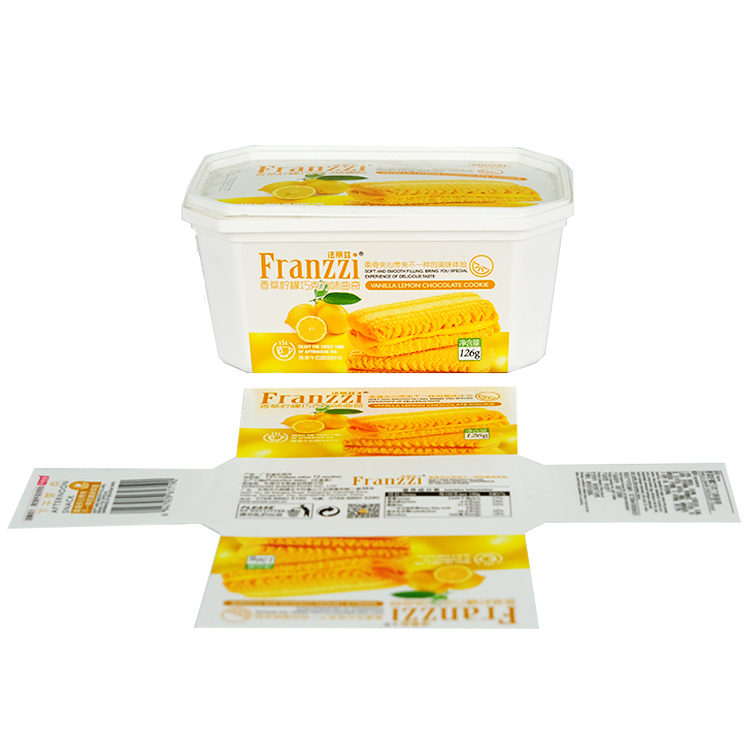
Orange peel surface finish — one of the texture options available alongside glossy and matte.
Matching Film Material to Container Material: PP, PE, and PET
The ZY-IML Series is produced on virgin PP, PE, and PET film, plus multi-layer composite laminated films, with food-grade options available. Film type options include complex white gloss film, complex transparent gloss film, standard gloss film, matte laminated film, and holographic film. Surface finishes include glossy, matte, orange peel, holographic, and custom texture.
PP is the reference point for most projects. Grand View Research puts PP at a 47.2% share of the in-mold labels market in 2023, and PP containers are the dominant substrate in injection-molded food and dairy packaging. PE film is specified where the container resin or the product chemistry calls for it. PET film is used where transparency or a different container material is involved. Because adhesion depends on how the film and the molten resin interact, the material decision should be made together with the injection molder rather than in isolation: the same ZY-IML film can perform differently on two resins even when every printed parameter is identical.
Multi-layer composite laminated films are used when a single material cannot deliver both the print surface and the bonding surface. In those projects, film formulation can be customized as part of the specification. Applicable industries for the series cover injection molding, food and beverage (yogurt, beverage, ice cream), daily chemicals (shampoo, detergent), pharmaceuticals, household products, industrial packaging (paint, lubricant buckets), and cosmetics.
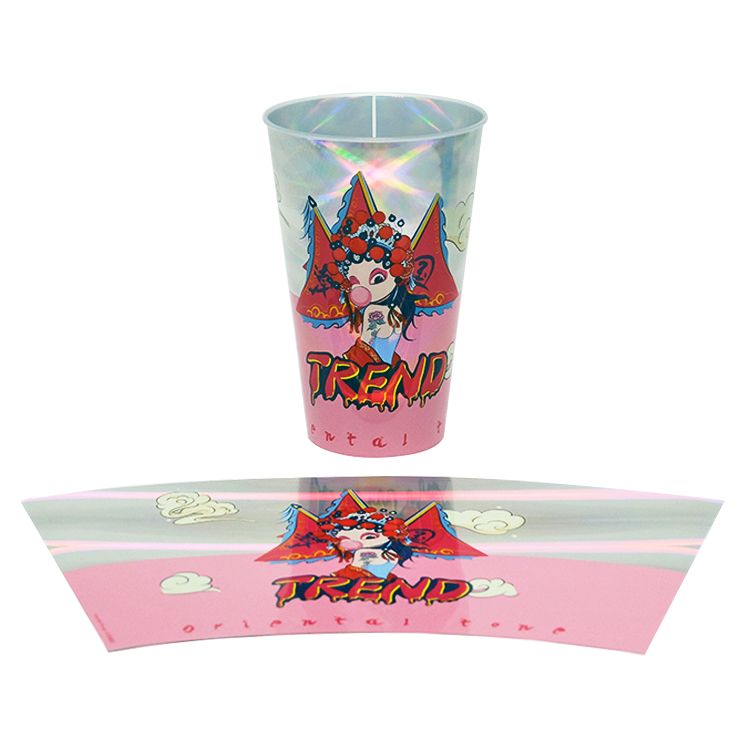
Holographic film — specified where shelf differentiation is a project requirement.
Step-by-Step: Specifying an IML Label for a New Container
- Define the container and the resin. Confirm whether the part is injection molded or blow molded, and identify the base resin — PP, PE, or PET. Both the film material and the adhesion requirement follow from this step.
- Map the full temperature envelope. Record filling temperature, any hot-filling or sealing step, cold-chain exposure, and end-use conditions. Compare the resulting range against the -20°C to 120°C working window.
- Set film thickness between 30μm and 100μm. Choose based on container geometry, required opacity, and whether labels are placed manually or by high-speed equipment.
- Fix the print specification. Decide the number of colours (up to 8), the artwork layout, and the required printing precision (±0.1mm). Confirm the layout fits within the maximum printing width of 1200mm.
- Confirm the compliance target market. Select food grade, daily chemical grade, or industrial grade, and confirm which standards apply — FDA 21 CFR, EU 10/2011, BRCGS, ISO22000, or QS.
- Run a sample before mass production. Samples are confirmed before the production clock starts. Lead time is 15–20 days after sample confirmation, and the minimum order quantity is 2000㎡.
- Scale up with defined quality control. Production quality control is 100% visual inspection plus random lab testing for FDA/GB compliance, supported by a monthly capacity of 350,000,000 pcs/month.
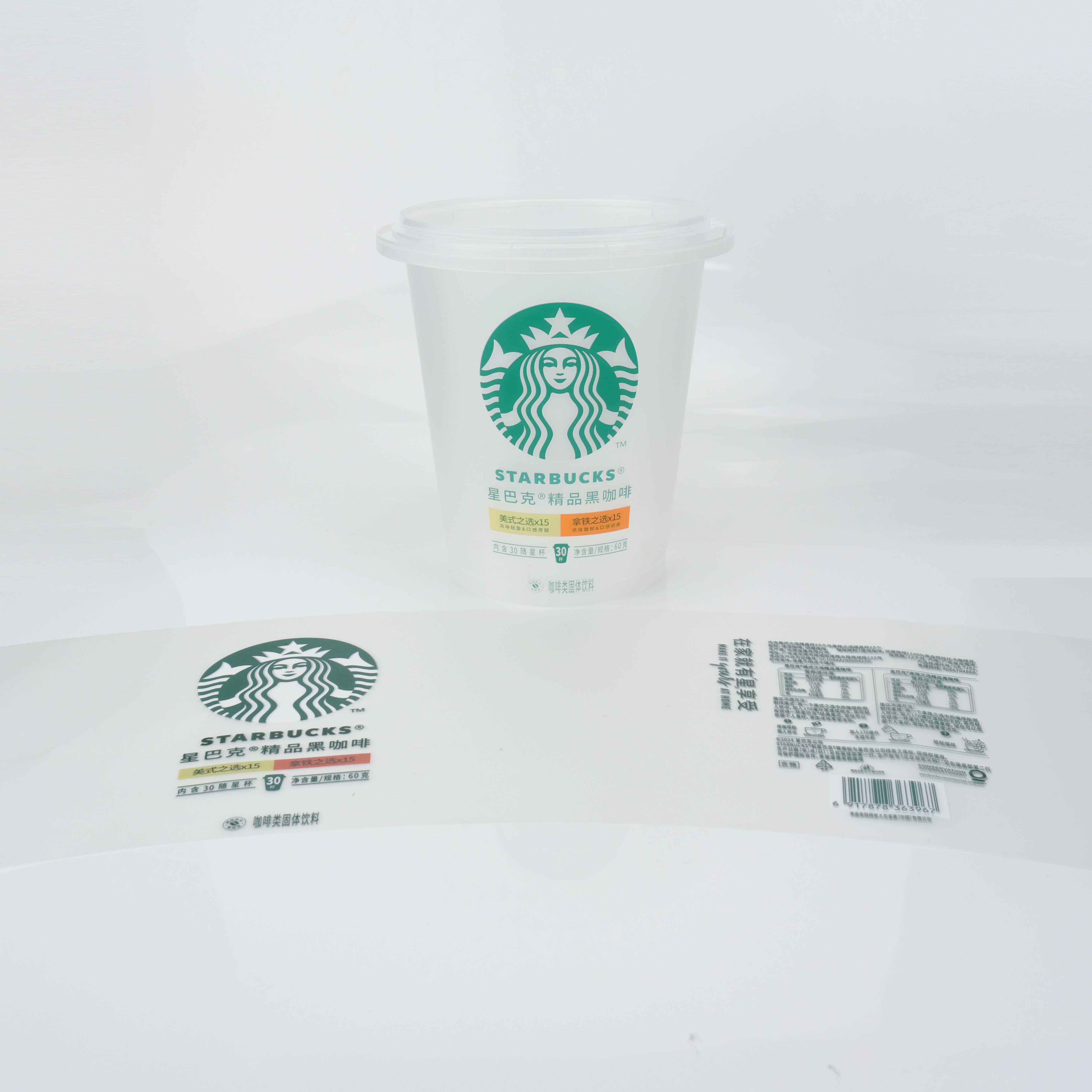
Transparent matte laminated film — used where contents visibility and a low-glare surface are both required.
Use Cases: Matching Specifications to Real Containers
Scenario fit is the practical test of a specification. The ZY-IML Series is used in food and beverage packaging, household appliances, cosmetics, and industrial chemicals applications, and requires food contact safety compliance with FDA/GB standards and non-toxic materials where food contact applies. Typical matching by container type looks like this.
Paint buckets and lubricant buckets. Industrial grade film with chemical resistance to weak acids, alkalis, and common detergents, plus 4H scratch resistance for stacked pails in warehouse conditions. Denser specifications within the 30μm–100μm thickness range suit pails that are handled roughly in the field.
Yogurt cups and ice cream containers. Food grade film on PP, with the -20°C to 120°C range covering both cold chain and any hot-fill step. Complex white gloss film is commonly used where opaque branding is required, while matte laminated film reduces glare on shelf under retail lighting.
Bubble tea cups and clear beverage cups. Food grade film with complex transparent gloss or transparent matte options, so the contents remain visible while the branding stays protected beneath the container surface.
Plastic bottles and blow molding projects. Blow-molded containers place different demands on film flexibility and forming behaviour than injected parts, and the ZY-IML Series covers blow molding in-mold labeling alongside high-speed injection processes.
Daily chemicals and cosmetic containers. Shampoo, detergent, and cosmetic packaging generally specifies chemical resistance plus surface finishes such as holographic, metallic, or custom texture for shelf differentiation.
A representative production reference: an international F&B and dairy brand project, produced with partner injection factories across DZ, EG, IN, IR, PK, PH, SA, TH, TR, TW, US, UZ, VN, and ZA, ran for one year on high-volume custom food-grade IML labels for cold beverage and yogurt cups. The reported outcomes were zero quality complaints, a 100% on-time delivery rate, and 100% compliance.
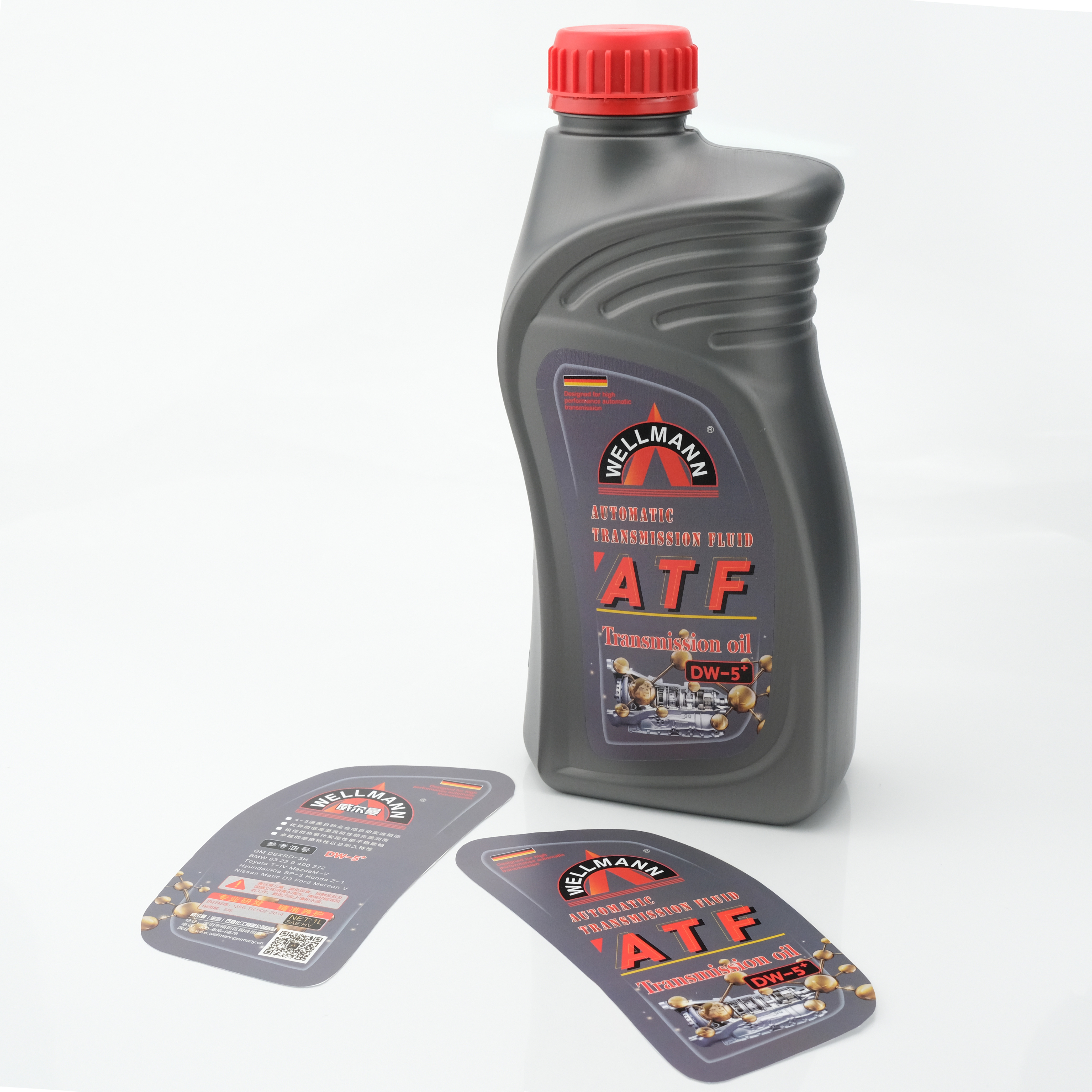
Matte white laminated film — used in blow molding in-mold labeling as well as injection molding.
Comparison Table: IML Parameters vs. Container Requirements
| Parameter | ZY-IML Series specification | What the buyer must confirm on the container side |
|---|---|---|
| Film thickness | 30μm – 100μm (customizable) | Container geometry, opacity requirement, label placement method |
| Adhesion strength | ≥5N, no peeling during injection molding | Actual base resin (PP / PE / PET) and cycle parameters |
| Temperature resistance | -20°C to 120°C | Fill temperature, cold chain, storage and transport conditions |
| Max printing width | 1200mm (customizable) | Label layout and number of labels across the web |
| Printing precision | ±0.1mm, 8-color rotogravure | Artwork registration tolerance on curved surfaces |
| Tensile strength | ≥20MPa | Web handling, cutting and automatic placement equipment |
| Scratch resistance | 4H (pencil hardness test) | Stacking, palletizing and distribution conditions |
| Chemical resistance | Weak acids, alkalis, common detergents | Product chemistry, especially paint and household chemicals |
All ZY-IML Series values are manufacturer specifications for the ZY-IML Series (food grade, daily chemical grade, industrial grade).
Frequently Asked Questions
Are in-mold labels food safe, and which standards do they meet?
Food grade ZY-IML Series labels are produced with food-grade low-migration water-based ink on virgin PP, PE, or PET film, and the migration test meets EU 10/2011 food contact material standards. The series is covered by FDA 21 CFR, BRCGS Packaging Materials, ISO22000, and QS certification. In the European Union, Regulation (EU) No 10/2011 applies to plastic materials intended to come into contact with food, while in the United States FDA 21 CFR Part 177 regulates polymers including PE and PP for direct food contact applications. Buyers should confirm which standard applies to their destination market before artwork is finalized, because compliance is decided by the market of sale, not by the printing method.
Can film thickness, size, colour, and film formulation be customized?
Yes. Customization covers size, shape, colour, printing design, and material, and film thickness is adjustable across 30μm to 100μm. Printing uses 8-color high-precision rotogravure with ±0.1mm precision on a maximum printing width of 1200mm, and film formulation can be customized for projects where a standard film does not fit. The ZY-IML Series is offered in food grade, daily chemical grade, and industrial grade, with film types including complex white gloss, complex transparent gloss, standard gloss, matte laminated, and holographic film.
What is the minimum order quantity?
The minimum order quantity for the ZY-IML Series is 2000㎡. Final quotation depends on the confirmed specification — film thickness, film type, surface finish, number of print colours, and compliance grade — so pricing is issued against a defined project rather than a catalogue line. Providing the container drawing, base resin, and target market at the enquiry stage is the fastest way to get an accurate figure.
Can we validate a sample before committing to mass production?
Yes. Sample confirmation is part of the standard process, and the 15–20 day production lead time begins after the sample is confirmed. Production quality control combines 100% visual inspection with random lab testing against FDA/GB compliance requirements, so the sample stage and the production stage are checked against the same criteria.
What lead time and capacity should be planned for?
Lead time is 15–20 days after sample confirmation, supported by a monthly capacity of 350,000,000 pcs/month. YZY manufactures under OEM/ODM arrangements and exports to the EU, US, Middle East, and Southeast Asia, with online technical support, after-sales consultation, and quality complaint handling as standard. To start a specification review, send the container drawing, base resin, and target market to yzy@inmoldlabel.net, or request a sample and quotation through www.inmoldlabel.net.
Conclusion
In-mold label selection is a specification exercise, not a design preference. Film thickness between 30μm and 100μm determines how the label forms and how much opacity it delivers. Adhesion strength of ≥5N determines whether it stays bonded through injection. Temperature resistance of -20°C to 120°C determines whether it survives cold chain and hot filling without distortion. Around those three numbers, a maximum printing width of 1200mm, 8-color rotogravure printing at ±0.1mm precision, tensile strength of ≥20MPa, and 4H scratch resistance define what the finished container can look like and how it will behave in distribution.
The most reliable route through a project is to fix the container, the resin, and the temperature envelope first, then select the ZY-IML Series grade, film type, and thickness that fit them.
Next step: send your container drawing, base resin, and target market to request a sample or a quotation. Email yzy@inmoldlabel.net, WhatsApp +86 182 6778 1866, or download the full product catalogue: YZY In-Mold Label Catalogue (PDF).
Have Questions or Need More Details?
Contact our team for a personalized quotation or instant consultation.
Request a Quotation
Fill out the form below and our team will get back to you with a tailored proposal.
WhatsApp Direct Chat
Prefer to chat in real-time? Message us on WhatsApp for instant assistance & quick answers.
- Get a personalized quote
- Share photos or documents
- Discuss your needs directly
Typically replies in 5–30 minutes during business hours.