Ranking In-Mold Label Applications: ZY-IML Series Fit by Compliance and Cost
Five in-mold label (IML) application scenarios are ranked here by how well the ZY-IML Series fits each one, with food-contact compliance weighted first, mechanical and thermal duty second, print complexity third and cost sensitivity last: 1) food packaging, 2) yogurt cups and cold-chain dairy, 3) paint buckets, 4) daily chemical packaging, 5) industrial packaging. The ranking is a specification-fit ranking for packaging buyers, not a ranking of suppliers or of market size.
ZY-IML Series is the in-mold label range manufactured by YZY (Zhejiang Zhongyu Technology Co., Ltd.), an IML producer founded in 2009 in Wenzhou, Zhejiang, China, whose product portfolio also covers sealing films, embossed lidding films and POF films. The series is positioned across food grade IML, daily chemical IML, industrial IML, yogurt cup IML and paint bucket IML formats, and the specification envelope behind this ranking — 30–100 μm film, 1200 mm print width, ±0.1 mm registration, ≥5N adhesion, 4H scratch resistance, ≥20 MPa tensile strength and a −20 °C to 120 °C service window — is the same envelope a buyer should test each scenario against.
Why IML Application Fit Is a Specification Problem Before It Is a Price Problem
Two quotations described as “PP in mold label” can reference different film thicknesses, different ink chemistries and different compliance documentation, so a straight price comparison across them is not a comparison of the same product. In IML, the label is placed in the mold before injection and fuses with the part under heat and pressure, becoming part of the molded component rather than a separate decoration applied afterwards. That means every printing and material decision is also a molding decision.
Under-specification shows up later in the project. A film or ink chosen for a non-food application may not carry the migration documentation a food pack requires. A label without sufficient adhesion can lift during high-speed injection. A surface without adequate hardness can scuff in transit and lose the shelf presentation the brand paid for. Over-specification is quieter but equally real: paying for a heavier film, a higher print count or a specialty finish on a container that only needs durable identification.
The practical consequence for buyers is that the application scenario — not the label format — should determine the specification. That is the logic behind the five-scenario ranking below.
Industry Background: What Buyers Are Actually Specifying
In-mold labeling is a decorating method in which a pre-printed label is inserted into the mold and bonded to the plastic part during forming. Polypropylene is the dominant material family in the category: Grand View Research reports that PP held 56.9% of the in-mold label market by material in 2025. That aligns with the technical convention that IML films are usually matched to the polymer family of the molded component, most commonly PP.
Film gauge is a second shared reference point. Standard IML film thickness typically ranges from 30 μm to 100 μm, and at least one supplier publicly describes 50–60 μm as its typical label gauge. Those figures are consistent with the ZY-IML Series range of 30–100 μm, which means film choice inside that band is a scenario decision rather than a category decision.
Compliance is the part of the specification that moves. The U.S. FDA updated its Inventory of Effective Food Contact Substance Notifications on 31 May 2026, announcing that FCNs for 35 PFAS substances are no longer effective. Regardless of how a specific label is formulated, the event illustrates a real procurement risk: food-contact documentation has a shelf life, and a report that was adequate at order placement may need review before the next season. Buyers who keep the specific report number and issue date on file are better positioned than buyers who keep a general “FDA compliant” statement.
Finally, process economics favour integrated decoration. Because labeling happens inside the molding cycle, separate label application steps disappear from the line. YZY positions its integrated injection-molding approach at 30% fewer process steps and a 20% lead-time reduction compared with applying labels after molding — an advantage that matters most in high-cavitation, high-volume programs.
How the Five Scenarios Were Ranked
Each scenario was assessed against five criteria, in this order of weight:
- Compliance exposure. How much food-contact or migration documentation the scenario requires, and how costly a documentation failure would be.
- Substrate and ink chemistry. Whether the container needs virgin food-grade resin and low-migration ink, or can tolerate a broader material set.
- Mechanical and thermal duty. Cold chain, hot fill, chemical contact, handling and abrasion seen between filling and retail.
- Print and decoration complexity. Colour count, registration tolerance and surface finish expectations.
- Cost sensitivity. How strongly the buyer will trade specification against unit cost and order volume.
The ZY-IML Series envelope used for the assessment is summarised below. It is the reference point for every ranking entry.
| Parameter | ZY-IML Series specification |
|---|---|
| Film thickness | 30 μm – 100 μm (customizable) |
| Film material | Virgin PP / PE / PET / multi-layer composite (food-grade available) |
| Printing method and colours | High-precision rotogravure, up to 8 colours (customizable) |
| Maximum printing width | 1200 mm (customizable) |
| Printing precision | ±0.1 mm, no colour deviation |
| Ink type | Food-grade low-migration water-based ink |
| Adhesion strength | ≥5N, no peeling during injection molding |
| Tensile strength | ≥20 MPa |
| Scratch resistance | 4H (pencil hardness test) |
| Operating temperature | −20 °C to 120 °C, suitable for cold chain and hot filling |
| Chemical resistance | Weak acids, alkalis and common detergents |
| Surface finishes | Glossy, matte, orange peel, holographic, custom texture |
| Molding compatibility | High-speed injection processes, no warping and no label fall-off |
| Compliance standards | FDA 21 CFR, BRCGS Packaging Materials, ISO22000, QS certified; migration test meets EU 10/2011 |
The Ranking: Five IML Applications, Best Fit First
RANK 1Food packaging — rigid containers, trays, lids and food cups
Food packaging ranks first because the scenario's dominant risk — food-contact compliance — is the area where the ZY-IML Series carries the most documented evidence. The series uses virgin PP/PE film grades with food-grade availability and food-grade low-migration water-based ink, which removes the recycled-content variability that complicates migration documentation in other film constructions.
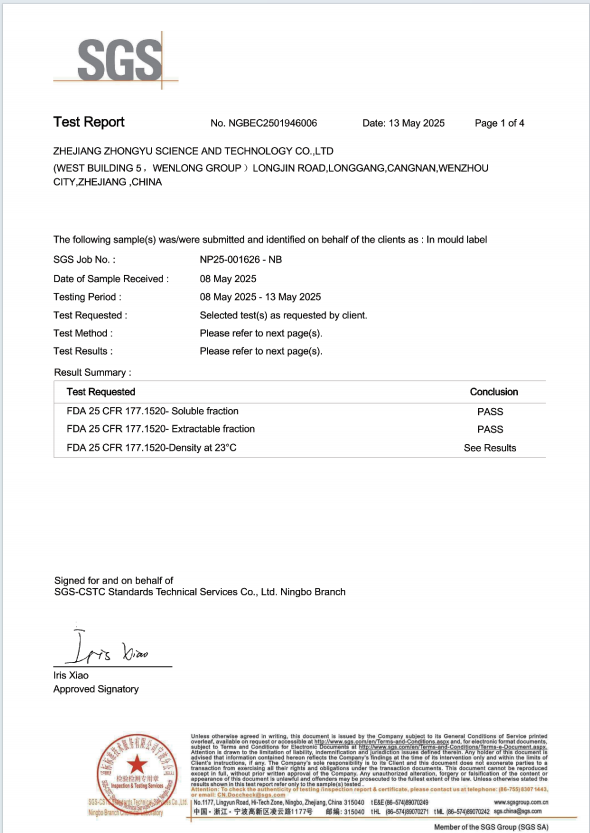
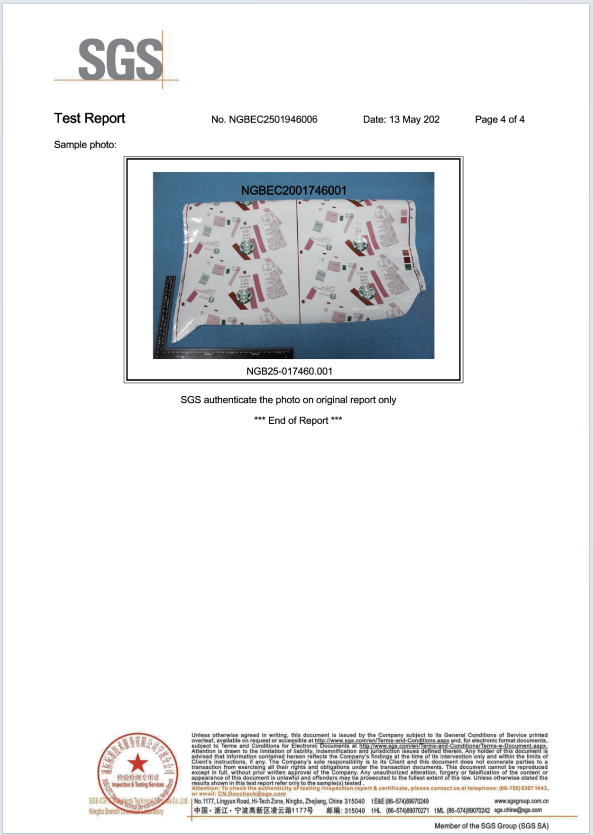
The documentation trail is specific rather than generic. YZY holds an SGS-issued FDA 21 CFR 177.1520 food contact test report, number NGBEC2501946006, issued 13 May 2025 and scoped to food contact packaging materials. The series is additionally stated as compliant with FDA 21 CFR, BRCGS Packaging Materials, ISO22000 and QS, and its migration test is stated to meet EU 10/2011 — the combination that a buyer shipping into both North America and Europe typically needs to assemble.
Functionally, the −20 °C to 120 °C window covers cold chain and hot filling in the same specification, and the 4H pencil-hardness surface protects print through filling, cartoning and retail handling. The cost driver in this scenario is documentation and film grade rather than decoration, so buyers should expect the specification conversation to be about resin source and ink system before it becomes a conversation about colour count.
RANK 2Yogurt cups and cold-chain dairy — including bubble tea cups and ice cream containers
Yogurt cups rank second because they combine a demanding compliance profile with a demanding molding profile. The pack is a thin-wall, high-cavitation injection part filled and stored cold, so the label must survive the injection cycle without warping or falling off and then survive distribution at −20 °C and below.
The ZY-IML Series specification addresses both ends: ≥5N adhesion with no peeling during injection molding, high-speed injection compatibility without label fall-off, and a lower temperature limit of −20 °C. The 4H scratch resistance and ±0.1 mm printing precision matter more here than in industrial work because multi-cavity dairy cups are compared side by side on shelf, and registration drift between cavities is visible to the consumer.
This is also the scenario with the clearest deployment evidence. A YZY project covering custom food-grade IML labels for cold beverage and yogurt cups ran for one year at high-volume mass production, served clients in 14 countries including the United States, Algeria, Egypt and India, and reported zero quality complaints, a 100% on-time delivery rate and 100% compliance. The same program used custom special effects — cold, heat and laser treatments — which is relevant because premium dairy and beverage launches increasingly use surface differentiation rather than additional print colours to separate SKUs.
RANK 3Paint buckets and coating containers
Paint buckets rank third. Compliance exposure is lower than in food, but the physical duty is higher: the label sits on a container that is stacked, dropped, stored in unheated warehouses and wiped down, and the pack frequently contacts alkaline or weakly acidic product residue around the rim.
This is where the ZY-IML Series chemical resistance statement carries the specification. The series is stated as resistant to weak acids, alkalis and common detergents, which maps directly onto water-based and many solvent-borne coating packs, and onto the detergents used to clean up spills. Combined with ≥5N adhesion and 4H surface hardness, the label stays fused to the bucket wall instead of lifting at the rim — the failure mode that drives buyers away from post-mold pressure-sensitive labels in this segment.
RANK 4Daily chemical packaging — detergents, cleaners and household products
Daily chemical packaging ranks fourth. Chemical exposure is comparable to paint buckets, but the decoration expectation is higher and the compliance conversation is more market-dependent, since household products sit outside food-contact rules while still facing retailer and brand-owner packaging specifications.
The ZY-IML Series supports this scenario mainly through decoration range and print control. Buyers can specify glossy, matte, orange peel, holographic or custom texture finishes, print up to 8 colours in high-precision rotogravure at ±0.1 mm registration, and use a maximum printing width of 1200 mm for multi-up layouts. For detergent bottles and household containers, that combination allows a brand to differentiate a value SKU with matte and a premium SKU with holographic on the same film family and the same molding line.
Cost in this scenario is driven by decoration complexity more than by compliance, which is why it ranks below paint buckets despite similar chemistry: the specification effort shifts toward print and finish approval rather than toward migration documentation.
RANK 5Industrial packaging — pails, technical containers and large-format parts
Industrial packaging ranks fifth because it is the most cost-sensitive scenario and the least decorated, so the ZY-IML Series is chosen mainly for durability and format capability rather than for compliance depth or finish range. Large-format industrial containers are where the 1200 mm printing width and the 30–100 μm film band do the most work: a heavier film can be selected for a part with a thicker wall and rougher handling profile, while a lighter gauge keeps material cost down on short-life packaging.
The ≥20 MPa tensile strength and 4H surface hardness support the basic industrial requirement — print that remains legible after stacking and transport — and the −20 °C to 120 °C window covers most ambient and heated storage conditions. Rank 5 is not a negative assessment; it reflects that the decisive variable here is unit cost at volume, so the specification should be held to what the application actually requires.
Step-by-Step: Applying the Ranking in a Live Project
The ranking is a starting position, not a finished specification. The sequence below converts it into a project plan that a packaging buyer can run with an injection molder and the label supplier in parallel.
Step 1 — Fix the container, resin and molding process
Confirm the part geometry, wall thickness and whether the container is injection molded, blow molded or thermoformed. IML is used across injection molding, blow molding and thermoforming, but the ZY-IML Series specification is written around injection molding compatibility — high-speed injection with no warping and no label fall-off. A blow molding or thermoforming program therefore needs explicit confirmation rather than an assumption carried over from an injection project.
Step 2 — Map the compliance route by destination market
For food-contact packs sold in the United States, the reference point is the FDA 21 CFR framework and the ZY-IML Series FDA 21 CFR 177.1520 test report NGBEC2501946006. For European food-contact programs, the relevant statement is the migration test meeting EU 10/2011. Site-level schemes — BRCGS Packaging Materials, ISO22000 and QS — sit alongside these as manufacturing system evidence. Record the report number and issue date in the project file so the documentation can be reviewed when regulations change.
Step 3 — Set the film specification inside the 30–100 μm band
Choose film thickness against wall thickness, part rigidity and handling profile, and choose the material against the container resin: virgin PP or PE, PET, or a multi-layer composite, with food-grade grades available. Match the surface finish to the shelf position — glossy for mainstream retail, matte or orange peel for a technical look, holographic for premium differentiation.
Step 4 — Set the print specification
Define colour count up to 8 colours, confirm that artwork fits within the 1200 mm maximum printing width for the chosen multi-up layout, and confirm that the ±0.1 mm registration tolerance is adequate for the smallest type in the design. For food applications, lock the food-grade low-migration water-based ink at this stage rather than after artwork approval.
Step 5 — Validate with a sample before releasing volume
Sample testing is the acceptance criterion in the purchasing terms, so the sample is the decision gate, not a formality. Test the sample on the actual mold and the actual filling line: check adhesion after molding, scratch resistance after handling, and appearance under the lighting used at retail. Typical production lead time is 15–20 days after sample confirmation, which makes the sample stage the main schedule lever in the project.
Step 6 — Lock production terms and quality control
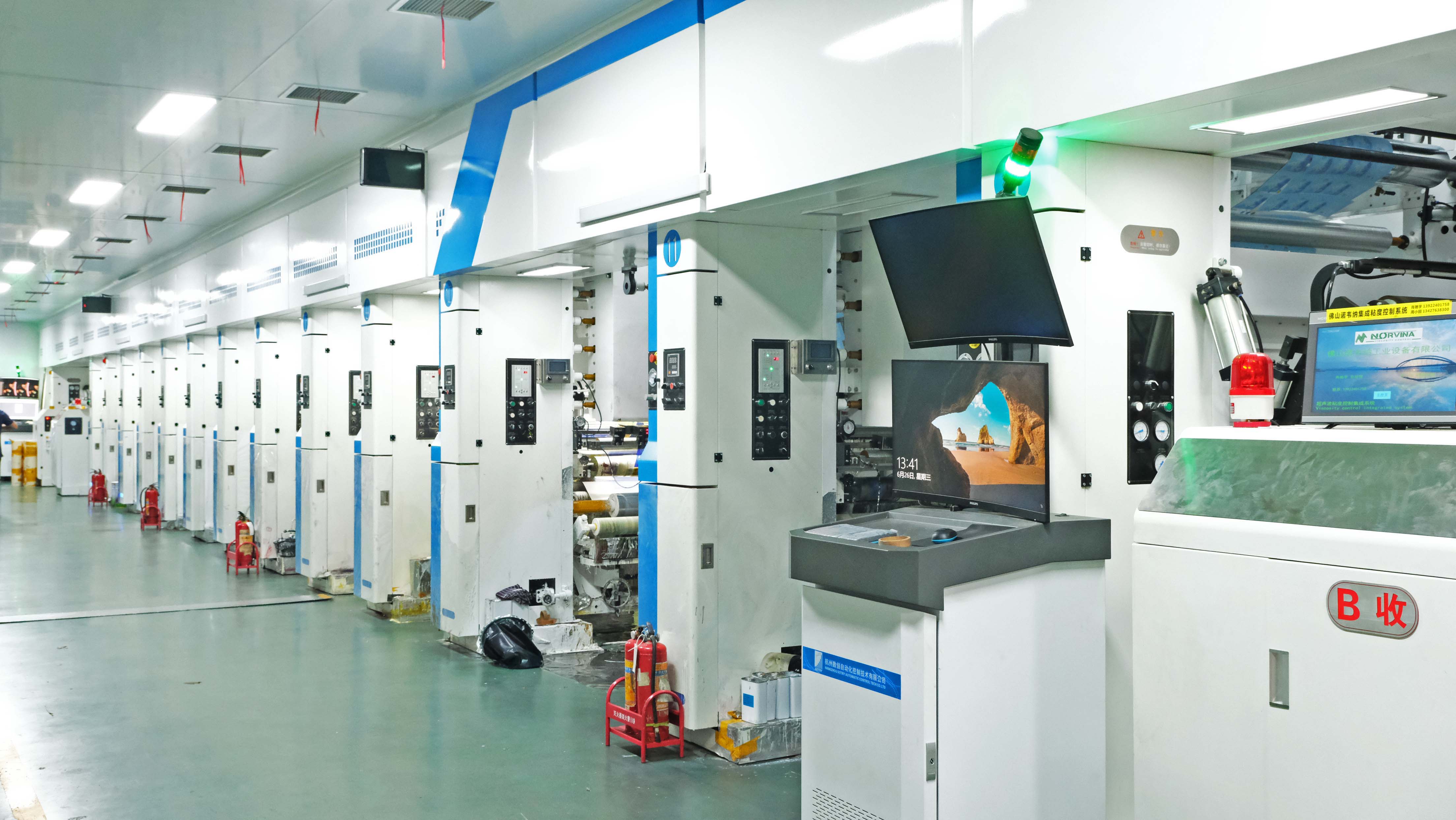
Volume production runs against a minimum order quantity of 2000 ㎡, with FOB or CIF delivery terms and 30/70 payment terms. Quality control is 100% visual inspection plus random lab testing to FDA and GB standards. Monthly capacity is 350,000,000 pcs, which is the figure to check against launch forecasts before committing a retail window.
Use Cases: Three Ways Buyers Apply This Ranking
New SKU launch with a fixed retail date. The buyer starts at Rank 1 or Rank 2 if the pack is food-contact, confirms the compliance document set, then uses the 15–20 day post-sample lead time as the critical path. The sample gate should be scheduled backwards from the filling date, not forwards from the purchase order.
Converting a paint bucket or daily chemical container from post-mold labels. The buyer starts at Rank 3 or Rank 4 and uses the conversion to eliminate a downstream labeling step. Because decoration happens inside the molding cycle, YZY's integrated approach is stated to reduce process steps by 30% and lead time by 20%; the buyer should verify that reduction against their own line rather than treating it as a universal figure.
Multi-market export program. The buyer starts at Rank 1 and builds one film and ink specification that carries both the FDA 21 CFR documentation and the EU 10/2011 migration statement, then applies the same specification to dairy, beverage and food container formats. The one-year, high-volume project covering food contact packaging and branding across clients in 14 countries — including the United States, Algeria, Egypt and India — is the closest available reference for this pattern, and it reported zero quality complaints, 100% on-time delivery and 100% compliance.
Comparison Table: Scenario Fit at a Glance
| Rank | Application scenario | Compliance exposure | Decisive ZY-IML Series parameters | Main cost driver |
|---|---|---|---|---|
| 1 | Food packaging (containers, trays, lids, food cups) | Highest — food contact in US and EU | FDA 21 CFR 177.1520 report NGBEC2501946006; BRCGS, ISO22000, QS; EU 10/2011 migration; virgin PP/PE; low-migration water-based ink | Compliance documentation, film grade |
| 2 | Yogurt cups, bubble tea cups, ice cream containers | High — food contact plus cold chain | ≥5N adhesion, no fall-off in high-speed injection; −20 °C lower limit; 4H scratch; ±0.1 mm registration | Volume, cavity count, special effects |
| 3 | Paint buckets and coating containers | Moderate — industrial, indirect food contact not applicable | Resistance to weak acids, alkalis and common detergents; ≥5N adhesion; 4H surface hardness | Label area, throughput, chemical validation |
| 4 | Daily chemical packaging | Moderate — retailer and brand specifications | Up to 8 colours at ±0.1 mm; glossy, matte, orange peel, holographic finishes; 1200 mm print width | Decoration complexity, finish selection |
| 5 | Industrial packaging and large-format pails | Lowest — durability-led | 30–100 μm film selection; ≥20 MPa tensile; 4H scratch; 1200 mm print width | Unit cost at volume, film gauge |
Ranking reflects specification fit against the ZY-IML Series envelope. It is not a market-size ranking and does not imply a ranking of suppliers within any scenario.
FAQ
1. Which compliance documents should a buyer request for food-grade in mold labels?
For food-contact polypropylene packaging sold in the United States, request the FDA 21 CFR 177.1520 test report and record its number and issue date. YZY holds an SGS-issued FDA 21 CFR 177.1520 food contact test report, number NGBEC2501946006, issued 13 May 2025 and scoped to food contact packaging materials. The ZY-IML Series is also stated as compliant with FDA 21 CFR, BRCGS Packaging Materials, ISO22000 and QS, and its migration test is stated to meet EU 10/2011. Buyers shipping into both North America and Europe should hold both the FDA report and the EU migration statement in the project file.
2. What can be customized on ZY-IML Series labels?
Customization covers size, shape, color, printing design and material, and YZY provides OEM and ODM production services. Within the series, film thickness is adjustable from 30 μm to 100 μm, printing runs up to 8 colours in high-precision rotogravure at ±0.1 mm registration with a maximum printing width of 1200 mm, and surface finishes include glossy, matte, orange peel, holographic and custom texture. Note that the published specification is built around injection molding compatibility; blow molding or thermoforming projects should be confirmed separately.
3. What is the minimum order quantity, and what drives the cost?
The minimum order quantity is 2000 ㎡, with FOB or CIF delivery terms and 30/70 payment terms. Cost is driven by film thickness within the 30–100 μm band, film material and grade, number of print colours, surface finish, label size and the compliance documentation the destination market requires. Because these variables combine differently per project, pricing is quoted per specification rather than published as a unit price.
4. How are samples validated before mass production?
Sample testing is the stated acceptance criterion in the purchasing terms. The sample should be run on the production mold and checked for adhesion after molding, scratch resistance after handling, print registration against the artwork, and appearance under retail lighting. Only after the sample is confirmed does the typical 15–20 day production lead time begin, so the sample stage is the schedule gate in the project.
5. What lead time and production capacity can be planned against?
Typical production lead time is 15–20 days after sample confirmation, and monthly capacity is 350,000,000 pcs. Quality control combines 100% visual inspection with random lab testing to FDA and GB standards, and after-sales support covers online technical support, after-sales consultation and quality complaint handling. To start a sample request or quotation for a specific scenario in this ranking, contact YZY at yzy@inmoldlabel.net or WhatsApp +86 182 6778 1866.
Conclusion
Ranking IML applications by fit produces a clear order for the ZY-IML Series: food packaging first, because compliance exposure is highest and the documentation stack — FDA 21 CFR 177.1520 report NGBEC2501946006, BRCGS, ISO22000, QS and EU 10/2011 migration — is most complete; yogurt cups and cold-chain dairy second, because the ≥5N adhesion, −20 °C limit and ±0.1 mm registration carry both the molding and the shelf requirement; paint buckets third, on the strength of weak-acid, alkali and detergent resistance; daily chemical packaging fourth, led by decoration range; and industrial packaging fifth, where unit cost at volume decides the specification.
The practical takeaway is that the ranking should be used to set the specification before the quotation, not to justify a specification after it. Film thickness, ink system, finish and compliance documentation all move together, and each scenario in this list changes which of those four dominates.
Next Step: Match the Ranking to Your Container
Send the container drawing, destination market and annual volume, and YZY will map the project to the correct ZY-IML Series specification and issue a sample for line validation. MOQ is 2000 ㎡, typical lead time is 15–20 days after sample confirmation, and monthly capacity is 350,000,000 pcs.
Download the full product and capability brochure: YZY brochure (PDF)
Website: www.inmoldlabel.net · Email: yzy@inmoldlabel.net · Tel / WhatsApp: +86 182 6778 1866
Contact: Holly · Address: Building 59, Zone E, Guohong Zhizao New Town, Xingke Road, Longgang, Wenzhou, Zhejiang, China, 325802

Have Questions or Need More Details?
Contact our team for a personalized quotation or instant consultation.
Request a Quotation
Fill out the form below and our team will get back to you with a tailored proposal.
WhatsApp Direct Chat
Prefer to chat in real-time? Message us on WhatsApp for instant assistance & quick answers.
- Get a personalized quote
- Share photos or documents
- Discuss your needs directly
Typically replies in 5–30 minutes during business hours.