How to Build a Region-by-Region IML Compliance File for EU, US & Middle East Buyers
How to Build a Region-by-Region IML Compliance File for EU, US & Middle East Buyers
A region-by-region IML compliance file is one indexed document set in which every piece of evidence carries the market it satisfies. For in-mold labels the file has four layers: market-specific food-contact test data — migration data to Regulation (EU) No 10/2011 for Europe and an FDA 21 CFR 177.1520 test report for the United States; substrate and ink credentials for the film actually being shipped; a QC evidence trail out of production; and the management-system certificates — BRCGS Packaging Materials, ISO 22000 and QS — that sit underneath all of it.
Packaging buyers rarely fail an audit because the evidence does not exist. They fail because a forty-page bundle arrives without an index, and the reviewer cannot tell which test supports which market, which film construction it was run on, or whether it still applies to the order on the table. This guide walks through building the file in that order — destination first, document second — using the document set that YZY (Zhejiang Zhongyu Technology Co., Ltd.), an in-mold label manufacturer founded in 2009 and based in Wenzhou, Zhejiang, China, issues with its ZY-IML-SERIES labels.
Problem definition: why one compliance pack does not travel across regions
Three failures repeat in IML sourcing projects, and all three are documentation failures rather than product failures.
- Document-to-market mismatch. A European reviewer receives an FDA report; a U.S. reviewer receives a migration statement written for the EU. Both documents may be genuine, and neither answers the question being asked.
- Construction mismatch. A food-contact test is quoted for “PP film” while the order is a specific white gloss film printed with a different ink system. The reviewer has no way to confirm that the tested construction is the shipped construction.
- Currency. Certificates sit in the folder without issue dates or scope, so the reviewer re-opens the entire qualification and the order slips by weeks.
The fix is structural rather than rhetorical: one file, four layers, and each document labelled with the market it serves and the construction it covers.
Industry background: what each market actually asks for
Europe: migration data under Regulation (EU) No 10/2011
Regulation (EU) No 10/2011 is the EU regulation on plastic materials and articles intended to come into contact with food. An EU buyer is not looking for a supplier declaration alone; the file is expected to carry migration test data for the plastic food-contact material. On ZY-IML-SERIES labels the documented position is that the migration test meets EU 10/2011 food contact material standards.
The EU layer also moves. EU 2025/351 sets stricter purity and recycled-content requirements for plastic food contact materials and applies from 16 September 2026, which means a European file assembled before that date should be re-verified against the current requirement rather than re-used unchanged.
United States: an FDA 21 CFR 177.1520 test report
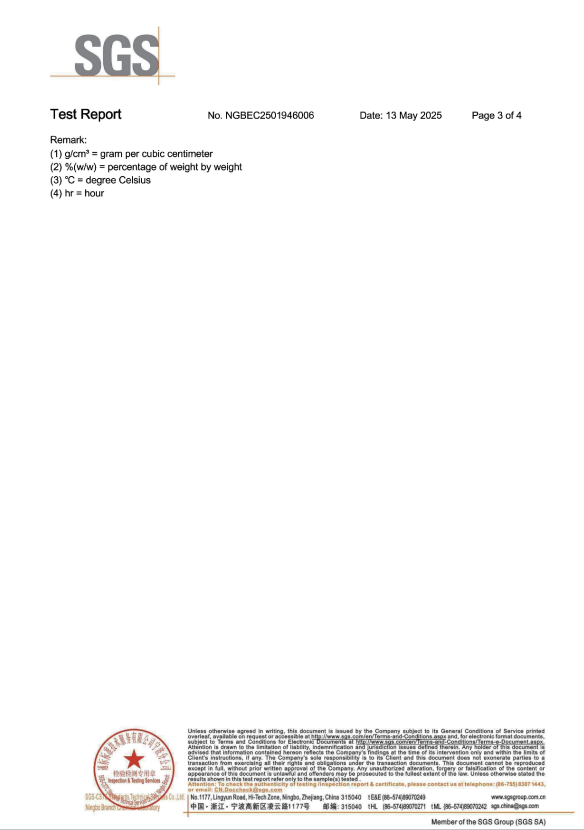
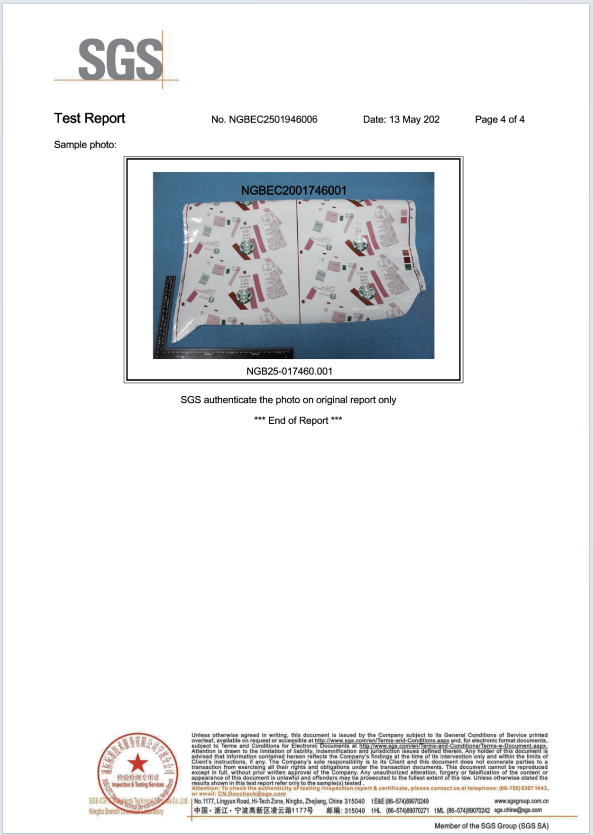
For the U.S. market the expected evidence is a food-contact test report citing FDA 21 CFR 177.1520. YZY’s report was issued by SGS under certificate number NGBEC2501946006, dated 13 May 2025, with the scope recorded as food contact packaging materials for the US / North America market and a recorded expiry of 31 December 2099. One page stating issuer, cited standard and date answers the U.S. layer faster than any brochure.
Every market: the management-system layer
Underneath the market-specific tests sits a layer that is not region-specific at all: BRCGS Packaging Materials, ISO 22000 and QS. These certificates tell a buyer that film sourcing, printing, conversion and inspection run inside an audited system rather than a one-off test. They are also the pages Middle East and Southeast Asian importers most often open first, because they transfer across borders when a buyer has no single national food-contact test requirement to point to.
Why the file must cover film and ink, not only the container
In-mold labels are integrated into the container during molding, eliminating a separate post-mold labeling step (Taghleef Industries product description). Because the label fuses into the container wall, the food-contact article a buyer imports includes the film and the printed ink, not only the plastic cup. Supplier descriptions put typical IML label film at 50 to 60 microns in white or transparent PP (Stratus Packaging product description); YZY specifies a 30 μm to 100 μm range on ZY-IML-SERIES, so whichever thickness appears on the purchase order is the thickness the test data has to match.
Detailed solution: the four-layer compliance file
Build the file in four layers. Each layer answers one question, and every document inside it carries a label stating the market and the construction it applies to.
Layer 1 — Market-entry test data
One page per market. For Europe, the EU 10/2011 migration position. For the United States, the SGS report to FDA 21 CFR 177.1520. Buyers in the Middle East and Southeast Asia usually receive both pages, because those two reports plus the management-system certificates are the documents that transfer across borders. Keep issuer, standard, certificate number and date on the page itself rather than in a covering email.
Layer 2 — Substrate and ink credentials
This is where most supplier files are thin. State the resin, the film thickness, the ink chemistry and the adhesion figure as supplied, then attach the evidence behind each line:
- Film material: virgin PP / PE / PET / multi-layer composite, food-grade available.
- Film thickness: 30 μm – 100 μm, customizable.
- Ink: food-grade low-migration water-based ink.
- Adhesion strength: ≥5 N, with no peeling during injection molding.
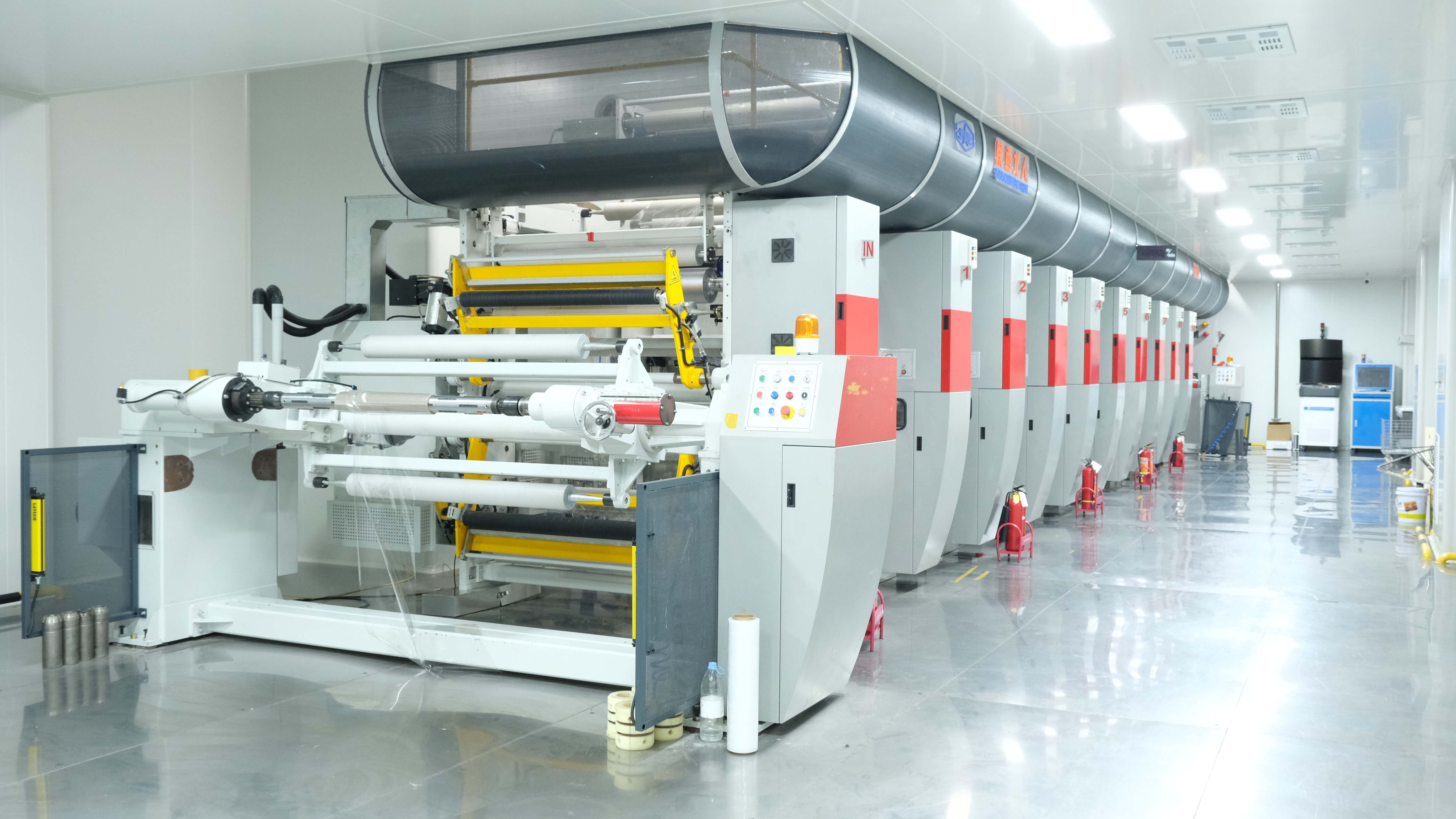
- Printing: high-precision rotogravure, up to 8 colors, ±0.1 mm printing precision, maximum printing width 1200 mm, customizable.
These values matter commercially because they are the parameters an EU or U.S. reviewer uses to decide whether the test report describes the same product that is being quoted.
Layer 3 — QC evidence trail
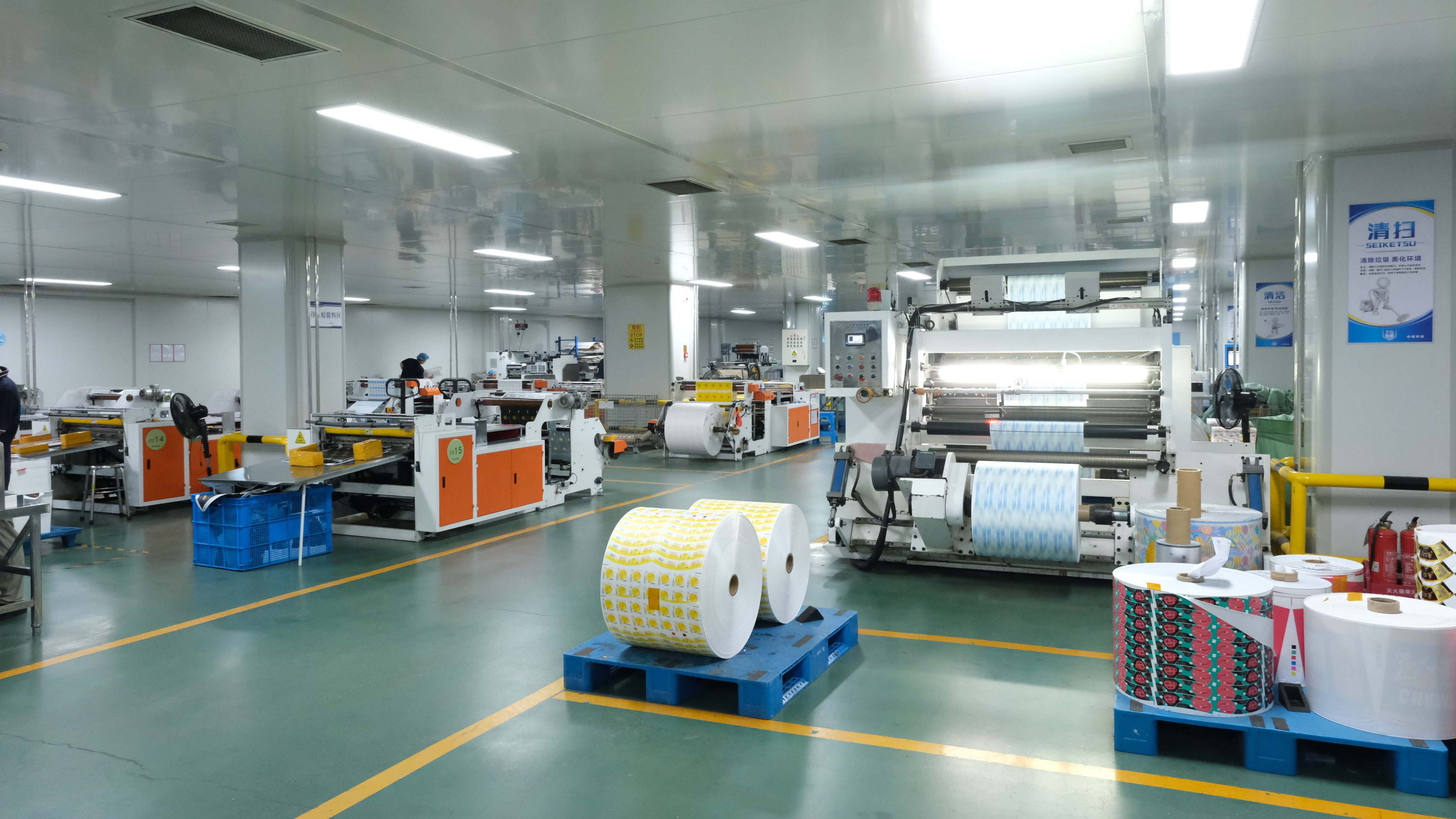
A test report describes a sample; the QC record describes the order. YZY’s stated quality control is 100% visual inspection plus random lab testing against FDA/GB compliance. In the file that becomes two artefacts: an inspection record tied to the batch or production window, and the laboratory result from the random draw with the standard named. Without the batch link, the QC page proves that a process exists, not that it was applied to this shipment.
Layer 4 — Management system and the living index
BRCGS Packaging Materials, ISO 22000 and QS certificates close the file, and an index page tells the reviewer which layer answers which market. Add the after-sales line as well: online technical support, after-sales consultation and quality complaint handling are part of the documented relationship, and buyers increasingly ask who owns a compliance question after delivery.
Step-by-step: assembling the file in seven steps
Step 1 — Fix the destination and the container before opening any folder
Write down three things: the destination market, the container format (yogurt cup, cold beverage cup, ice cream container, paint bucket, plastic bottle, plastic bucket) and the molding process. Supplier descriptions identify injection molding, blow molding and thermoforming as processes that can use IML, with the label fused to the package during forming (Stratus Packaging product description). Process choice changes what the label has to survive, so it belongs on page one, not in an appendix.
Step 2 — Pull only the market-specific test data
For an EU destination the first page is the EU 10/2011 migration position. For a U.S. destination the first page is the SGS report to FDA 21 CFR 177.1520. For Middle East and Southeast Asian destinations, supply both and confirm with the buyer whether a national requirement sits on top of them.
Step 3 — Verify substrate credentials against the declared film
Match the resin and thickness on the quotation to the film statement in the file. Material options are virgin PP, PE, PET and multi-layer composite with food-grade grades available; thickness runs from 30 μm to 100 μm and is customizable. If the buyer’s pack is a white PP film in the 50–60 μm band described by other converters, the file should state that figure explicitly instead of quoting the whole range.
Step 4 — Treat ink as a separate compliance item
Ink is where a food-grade label can quietly stop being food-grade. Name the ink system — food-grade low-migration water-based ink — and show that it sits inside the tested construction. Add the performance data buyers use as a proxy for process robustness: adhesion ≥5 N, operating temperature range of −20 °C to 120 °C, tensile strength ≥20 MPa, 4H pencil-hardness scratch resistance, resistance to weak acids, alkalis and common detergents, and compatibility with high-speed injection processes without warping or label fall-off.
Step 5 — Attach the QC evidence trail and make it batch-traceable
Attach the 100% visual inspection record and the random lab test result against FDA/GB compliance, and reference the production window. This is also the moment to state capacity honestly: 350,000,000 pcs/month on OEM/ODM production, with customization of size, shape, color, printing design and material.
Step 6 — Add the management-system layer with dates and scope
List BRCGS Packaging Materials, ISO 22000 and QS on one page with scope and validity, then cross-reference the FDA report — issued 13 May 2025, recorded expiry 31 December 2099, certificate NGBEC2501946006. One page, four lines, no scanned bundle.
Step 7 — Lock the file to commercial terms
Compliance approval and purchase approval should move together. Put the commercial terms on the same page as the document index: MOQ 2,000 m², lead time 15–20 days after sample confirmation, payment terms 30/70, delivery FOB/CIF, acceptance criteria sample test. When the reviewer signs the file, the buyer already knows what is being ordered and when it ships.
Use cases: re-indexing the same file for different buyers
Cold beverage and yogurt cups for a multi-country F&B and dairy brand
YZY’s referenced case is custom food-grade IML for cold beverage and yogurt cups, produced at high volume for an international F&B and dairy brand working through an injection factory, with markets including the United States, Saudi Arabia, Egypt, Turkey, India, Pakistan, the Philippines, Thailand, Vietnam, Algeria, Iran, Taiwan, Uzbekistan and South Africa. The reported outcome is 0 quality complaints, a 100% on-time delivery rate and 100% compliance over the project period. For a buyer in this position the pack is one file with a different lead page per destination — EU 10/2011 for Europe, the SGS report for the United States.
Paint buckets and industrial containers
Industrial IML is not automatically a food-contact conversation, but the document set still has to prove durability: adhesion ≥5 N with no peeling during injection molding, a −20 °C to 120 °C operating range, and resistance to weak acids, alkalis and common detergents. For a paint bucket program the file leads with the performance layer and the management-system certificates, while the food-contact reports stay inside the same pack for brands that also buy food packaging from the same printer.
Middle East importers
Middle East buyers — Saudi Arabia, Egypt and Iran appear in the referenced case list — work from the transferable layer: the SGS FDA 21 CFR 177.1520 report, the EU 10/2011 migration position, and BRCGS Packaging Materials, ISO 22000 and QS certificates. Because no single regional document replaces these, present them as a set with an index explaining what each one proves, and confirm any additional national import requirement with the buyer before the order is placed.
Southeast Asian converters and brand owners
Southeast Asia appears in the same case list (Philippines, Thailand, Vietnam, India, Pakistan) and is named among YZY’s export markets alongside the EU, the US and the Middle East, where 30% of output is exported. These buyers tend to re-order in shorter cycles, which is where lead-time documentation earns its place: 15–20 days after sample confirmation, supported by 350,000,000 pcs/month of capacity, keeps a repeat order from turning into a re-qualification.
Comparison table: matching each document to the market it serves
Use this matrix as the index page of the file. The right-hand column records the status YZY documents for ZY-IML-SERIES labels.
| Document | Market it answers | What the reviewer should check | Status in the YZY file |
|---|---|---|---|
| Migration test position to EU 10/2011 | EU | that the tested construction matches the film and ink being supplied | Meets EU 10/2011 food contact material standards |
| FDA food contact test report | US / North America | issuer, standard cited, issue date, scope | Issued by SGS, certificate NGBEC2501946006, FDA 21 CFR 177.1520, dated 13 May 2025, scope: food contact packaging materials, recorded expiry 31 December 2099 |
| BRCGS Packaging Materials certificate | Global retail and export programs | scope and validity of the certificate | Certified |
| ISO 22000 certificate | Global | food safety management scope | Certified |
| QS certificate | China / domestic production | production quality system coverage | Certified |
| QC record: 100% visual inspection plus random lab testing | All markets | batch linkage and the standard named in the lab result | Standard procedure, tested against FDA/GB compliance |
| Film and ink specification sheet | All markets | resin type, thickness, ink chemistry, adhesion figure | Virgin PP/PE/PET/multi-layer composite (food-grade available), 30–100 μm, food-grade low-migration water-based ink, adhesion ≥5 N |
The second table ties the commercial half of the file to the same page, so that a document approval and a purchase approval do not drift apart.
| Commercial term | Value | Why it belongs in the compliance file |
|---|---|---|
| Minimum order quantity | 2,000 m² | Defines the volume at which a full document review is worth running |
| Lead time | 15–20 days after sample confirmation | The clock starts on sample approval, not on the purchase order |
| Payment terms | 30/70 | Split payment tied to order placement and shipment |
| Delivery terms | FOB / CIF | Decide which side owns freight before documents are issued |
| Acceptance criteria | Sample test | The approved sample is the physical reference for the production run |
FAQ
Which documents does an IML compliance file need for EU and US buyers?
For a European destination the file needs a migration test position referencing Regulation (EU) No 10/2011; for the United States it needs a food contact test report citing FDA 21 CFR 177.1520. YZY’s report is issued by SGS under certificate number NGBEC2501946006, dated 13 May 2025, with scope recorded as food contact packaging materials and a recorded expiry of 31 December 2099. Both pages are supported by BRCGS Packaging Materials, ISO 22000 and QS certificates.
Can the QC records be tied to the batch I actually receive?
Yes, if the file is built that way. YZY’s quality control is 100% visual inspection plus random lab testing against FDA/GB compliance, and the inspection record and laboratory result are linked to the production window rather than to a single historical sample. That link matters at 350,000,000 pcs/month of OEM/ODM output, where customization of size, shape, color, printing design and material means each order is its own construction.
What are the MOQ, payment and delivery terms behind the file?
YZY’s purchasing terms are a MOQ of 2,000 m², payment terms of 30/70, and delivery terms of FOB or CIF. Acceptance criteria are sample test, which means the approved physical sample — not the specification sheet — is the reference for the production run.
How do I validate the file against a physical sample?
Test the sample against the declared construction: film thickness within the 30–100 μm range, food-grade low-migration water-based ink, adhesion ≥5 N with no peeling during injection molding, and an operating range of −20 °C to 120 °C if the pack goes through cold chain or hot filling. Once the sample passes, it becomes the acceptance reference, and the file is re-indexed against it.
How long does production take once the file is approved?
Lead time is 15–20 days after sample confirmation, across export markets including the EU, the US, the Middle East and Southeast Asia, with online technical support, after-sales consultation and quality complaint handling after delivery. The practical next step is to request the document pack and a sample together, so that the compliance review and the physical trial run on the same timeline — contact Holly at yzy@inmoldlabel.net or +86 182 6778 1866 to start both.
Conclusion
A region-by-region IML compliance file is not a thicker brochure. It is an indexed decision tool in which the EU migration position, the FDA 21 CFR 177.1520 test report, the substrate and ink credentials, the QC trail and the BRCGS Packaging Materials, ISO 22000 and QS certificates each answer a named question for a named market. Built in that order, the same pack serves a yogurt cup program in Europe, a cold beverage cup program in the United States, a paint bucket program in Southeast Asia and an importer in Saudi Arabia without being rebuilt for each one.
The file is complete when a reviewer can answer six questions from the index alone:
- Which market — the destination stated on the purchase order.
- Which test — the EU 10/2011 migration position or the FDA 21 CFR 177.1520 report.
- Which construction — resin, exact thickness within the 30–100 μm range, and ink system.
- Which batch — the 100% visual inspection record and the random lab result tied to that production window.
- Which management system — BRCGS Packaging Materials, ISO 22000 and QS, with scope and dates.
- Which commercial terms — 2,000 m² MOQ, 15–20 days after sample confirmation, 30/70 payment, FOB/CIF, sample-test acceptance.

Request the IML document pack and a sample
YZY (Zhejiang Zhongyu Technology Co., Ltd.) runs OEM/ODM production of ZY-IML-SERIES in-mold labels from a 20,000 m² facility with 250 employees, supplying food-grade IML for cold beverage cups, yogurt cups and industrial containers to the EU, the US, the Middle East and Southeast Asia.
Ask for the region-specific document pack, a printed sample and a quotation in one request: Holly · yzy@inmoldlabel.net · +86 182 6778 1866 · WhatsApp.
Download the YZY product brochure (PDF) or visit inmoldlabel.net for the full label range.
Address: Building 59, Zone E, Guohong Zhizao New Town, Xingke Road, Longgang, Wenzhou, Zhejiang, China, 325802.
Have Questions or Need More Details?
Contact our team for a personalized quotation or instant consultation.
Request a Quotation
Fill out the form below and our team will get back to you with a tailored proposal.
WhatsApp Direct Chat
Prefer to chat in real-time? Message us on WhatsApp for instant assistance & quick answers.
- Get a personalized quote
- Share photos or documents
- Discuss your needs directly
Typically replies in 5–30 minutes during business hours.