US In-Mold Label Compliance: FDA 21 CFR 177.1520 & SGS Certification
US In-Mold Label Compliance: FDA 21 CFR 177.1520 & SGS Certification
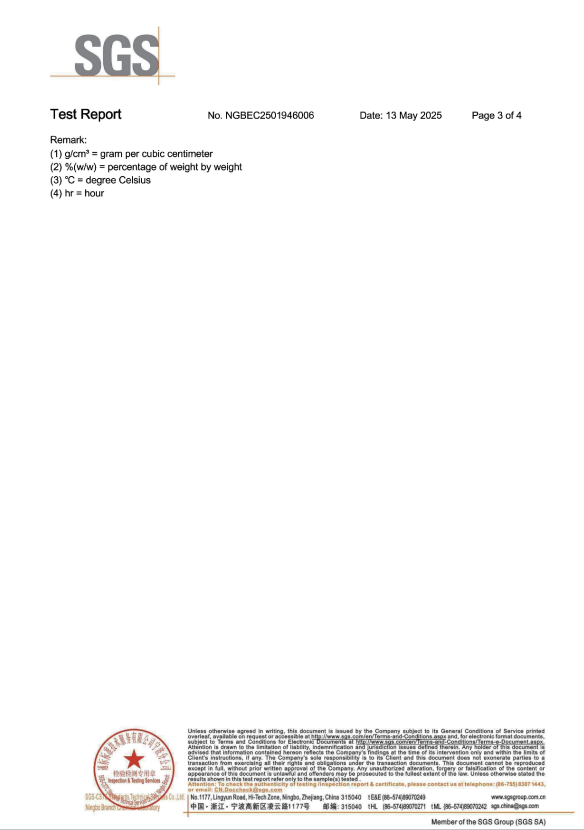
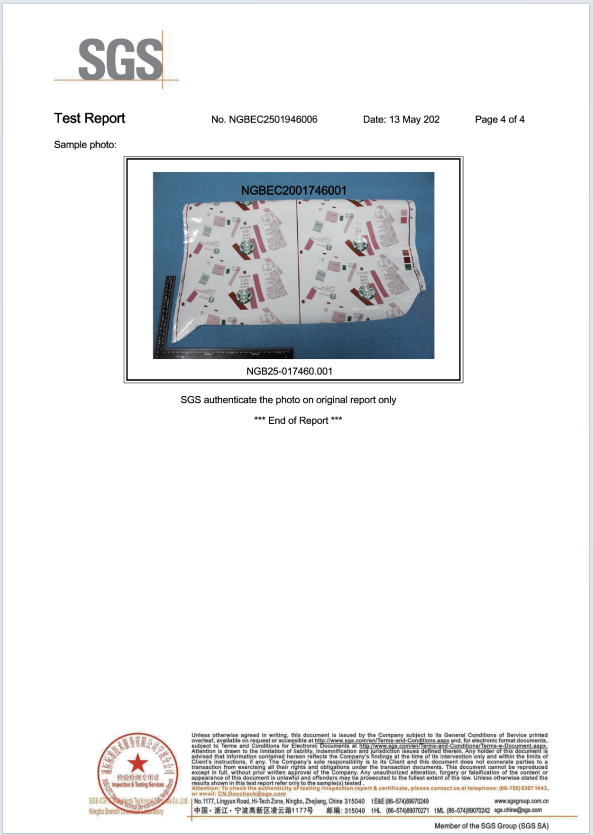
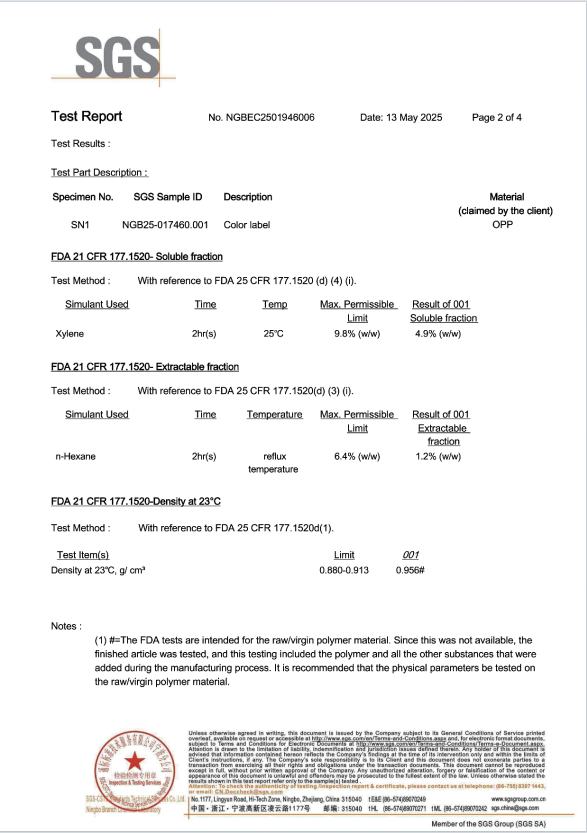
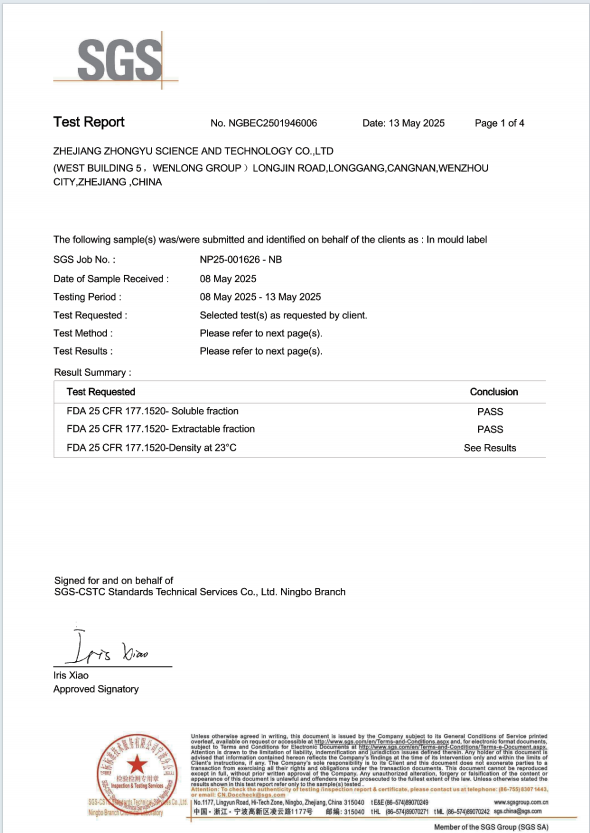
The ZY-IML-SERIES in-mold label is certified under an SGS-issued FDA Food Contact Test Report, certificate number NGBEC2501946006, tested against the FDA 21 CFR 177.1520 standard for the US market. The certification covers the ZY-IML-SERIES in-mold label product series and is supported by company-level BRCGS, ISO 22000, and QS certifications. For a US food contact labeling project, that combination is the documentation set a brand owner, injection molder, or retailer compliance team will request before releasing production.
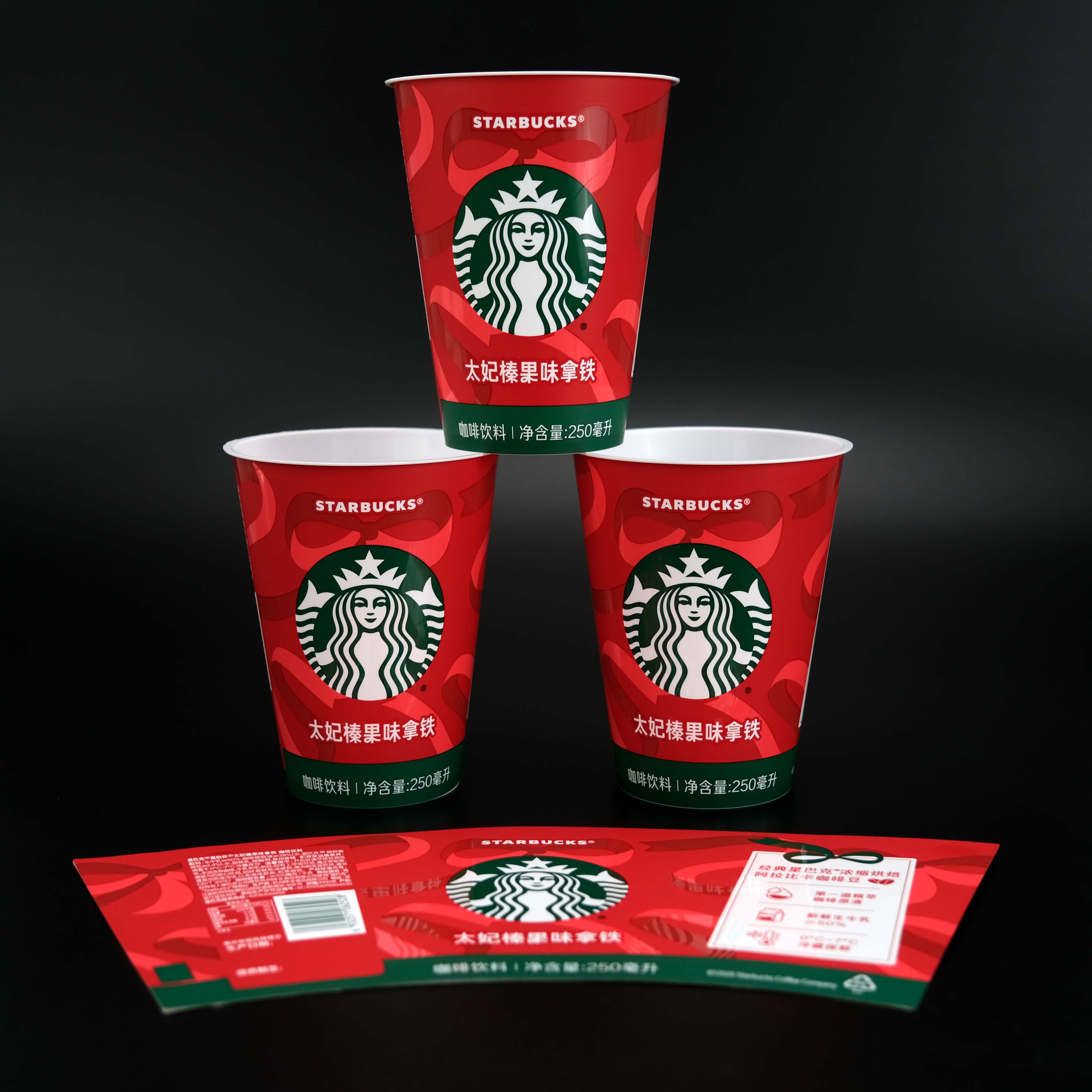
In-mold labels (IML) are printed films placed into the mold cavity and fused to the plastic container during injection molding or blow molding. The label becomes part of the container wall, which means the film, the ink, and the coating all sit inside the same food contact review as the container itself. That is the reason a US buyer cannot treat an in-mold label as a print purchase alone.
Why US In-Mold Label Projects Stall on Documentation, Not Print
Most in-mold label projects that stop in the US market do not stop on press. They stop at the compliance desk. A label can print cleanly, mold without peeling, and survive cold-chain handling, and still block a product launch because the supplier cannot produce a test report that names the standard, the testing body, the certificate number, and the exact product it covers.
Three questions decide whether a compliance file moves forward:
- Which standard applies to this product? For polypropylene (PP) and polyethylene (PE) films intended for direct food contact, the relevant US reference sits inside FDA 21 CFR Part 177, which regulates polymers used in food contact applications. The specific section cited in the ZYZ SGS report is 21 CFR 177.1520.
- Who issued the evidence, and under what number? A test report becomes verifiable when it carries an issuing body and a traceable number. For the ZY-IML-SERIES, that is SGS and certificate number NGBEC2501946006.
- Which product does it cover? A report issued for one film grade does not automatically extend to every item in a catalogue. Scope language matters: the SGS report for the ZY-IML-SERIES is issued for the in-mold label product series, within a food contact packaging materials scope, for the US and North America market.
The third question is where files usually break. Buyers frequently receive a document that proves a supplier uses food-grade raw material, but not a document that ties a defined standard to a defined product series. When the compliance team asks for the second type and only the first exists, the packaging specification is returned for revision.
The core answer for the ZY-IML-SERIES: certification from SGS, certificate number NGBEC2501946006, based on the FDA 21 CFR 177.1520 standard, confirming compliance with FDA Food Contact Test Report requirements for the US market, and covering the ZY-IML-SERIES in-mold label product series.
Where FDA 21 CFR 177.1520 Fits in the US Framework
US FDA 21 CFR Part 177 regulates polymers, including PE and PP, for direct food contact applications. The in-mold label films in the ZY-IML-SERIES are built on food-grade virgin PP and PE resin, with PET and multi-layer composite laminated films available as alternative constructions. The polymer family used in production and the standard cited in the test report are therefore aligned rather than adjacent.
That alignment is the technical point a packaging engineer checks first. If a label film is made from a polymer family outside the scope of the cited section, the report — however official it looks — does not describe the product being purchased.
Market context behind the compliance pressure
Compliance scrutiny on IML has grown together with the label format itself. Grand View Research valued the global in-mold labels market at USD 2.31 billion in 2023, with a projected value of USD 3.14 billion by 2030. Market Research Future estimated the same market at USD 2.72 billion in 2024 with a projected CAGR of 3.94% to USD 4.16 billion by 2035. Published estimates differ because base years and segmentation definitions differ, so these figures are best used as directional indicators rather than a single agreed number.
What the sources agree on is where the volume sits. Grand View Research reported that the food and beverage segment accounted for the largest revenue share of over 41.3% of the in-mold labels market in 2023, that polypropylene holds a 47.2% share by material, and that injection molding leads the production process segment with a revenue share exceeding 57.1%. Mordor Intelligence identifies Asia Pacific as both the largest and the fastest-growing regional market as of 2024. Each of those signals points to the same conclusion: food contact labeling is the mainstream IML application, and it is the segment where documentation is examined most closely.
The ZYZ Compliance File for the ZY-IML-SERIES
ZYZ (Zhejiang Zhongyu Technology Co., Ltd.) is an in-mold labeling manufacturer founded in 2009, operating a 20,000 m² facility with 250 employees and a 10-person R&D team, producing in-mold labels, sealing films, embossed lidding films, and POF films for worldwide markets. Its ZY-IML-SERIES is the product line that carries the US food contact certification discussed here.
The compliance file has two layers. The first is product-level and US-specific: an FDA Food Contact Test Report issued by SGS, certificate number NGBEC2501946006, referencing FDA 21 CFR 177.1520, issued on 2025-05-13 with a validity recorded to 2099-12-31, scoped to food contact packaging materials and to the US and North America market. The second layer is company-level: QS, ISO, and BRC certifications, including BRCGS Packaging Materials and ISO 22000, applied across production rather than to a single SKU.
What each document actually proves
| Document | Issued by / system | Reference | Scope in the file |
|---|---|---|---|
| FDA Food Contact Test Report | SGS | FDA 21 CFR 177.1520 | ZY-IML-SERIES in-mold label; food contact packaging materials; US / North America market; certificate number NGBEC2501946006 |
| BRCGS certification | BRCGS Packaging Materials system | Packaging materials manufacturing | Company-level production and quality management |
| ISO 22000 certification | Food safety management system | ISO 22000 | Company-level food safety management |
| QS certification | Quality safety system | QS | Company-level production qualification |
| Migration testing | Laboratory testing | EU 10/2011 food contact material standards | Supporting reference for EU-bound volumes of the same series |
Note on scope: the SGS FDA Food Contact Test Report is the US-market document. EU 10/2011 migration testing is a separate reference point and should be treated separately when a project ships into European markets.
Step-by-Step: How a Buyer Verifies an IML Compliance Claim
The verification sequence below is the one that survives a retailer or brand compliance review, because each step produces a document rather than an assurance.
- Request the certificate number and the issuing body. A test report should identify who tested and under what number. For the ZY-IML-SERIES, the number is NGBEC2501946006 and the issuing body is SGS.
- Read the cited standard against the material. Confirm that the standard named in the report covers the polymer family used in the film. The ZY-IML-SERIES uses food-grade virgin PP and PE, with PET and multi-layer composites available, and the US report cites FDA 21 CFR 177.1520.
- Confirm the scope language covers the series being purchased. Check that the report names the product series and the market it applies to — in this case the ZY-IML-SERIES, food contact packaging materials, US / North America.
- Check the date and validity line. The report was issued on 2025-05-13, with validity recorded to 2099-12-31. Confirm that the version you receive is the current record.
- Layer in the management system documents. QS, ISO, and BRC certifications, BRCGS Packaging Materials, and ISO 22000 describe how the plant controls materials and processes, not just what one sample tested at. For an annual supply agreement, this layer is what keeps the file valid across repeat orders.
- Confirm production control and traceability. ZYZ applies 100% visual inspection plus random laboratory testing for FDA and GB compliance, with strict inspection standards applied from raw material through production to finished product.
- Hand the technical data to the injection molder. Compliance and process parameters have to agree. Film thickness runs 30μm to 100μm, adhesion strength is ≥5N with no peeling during injection molding, and the operating temperature range is -20°C to 120°C, which covers hot filling and cold chain conditions.
Grade Selection: Which ZY-IML-SERIES Label Needs Which Documentation
The ZY-IML-SERIES is produced in food grade, daily chemical grade, and industrial grade variants. The food contact certification is most directly relevant to the food grade line, and the distinction matters when a brand runs several product families through the same molding partner.
| Grade | Typical containers | Compliance focus | Relevant series parameters |
|---|---|---|---|
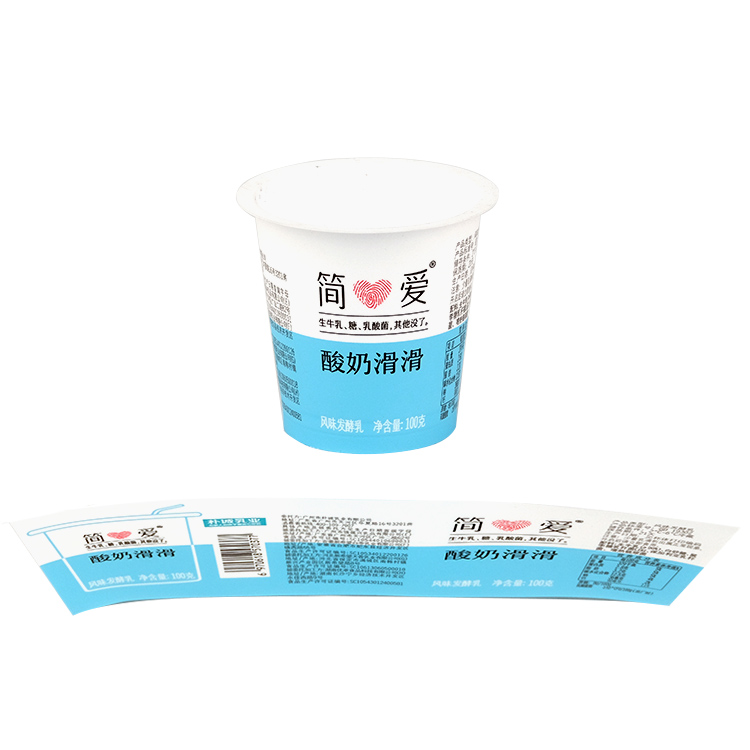
| Food Grade IML | Yogurt cups, ice cream containers, bubble tea cups, beverage bottles, other food containers | FDA food contact documentation; migration control; food-grade ink | FDA 21 CFR, BRCGS, ISO 22000, QS listed compliance standards; food-grade low-migration water-based ink; migration testing per EU 10/2011 |
| Daily Chemical IML | Shampoo, detergent, and cosmetic containers | Chemical resistance and print durability rather than food contact | Resistance to weak acids, alkalis, and common detergents; scratch resistance 4H (pencil hardness test) |
| Industrial IML | Paint buckets, lubricant buckets, industrial plastic buckets | Adhesion and chemical exposure during filling and use | Adhesion strength ≥5N; tensile strength ≥20MPa; temperature range -20°C to 120°C |
The practical rule for procurement: a project that holds food or drink should be specified at food grade from the start. Substituting a daily chemical or industrial grade film into a food container moves the project outside the scope of the food contact documentation.
Technical Parameters That Support the Compliance Claim
Documentation is only useful if the physical product behaves in the molding cell. The parameters below are the ones most often requested alongside the test report in a US project specification.
- Film and material: food-grade virgin PP and PE, with PET and multi-layer composite laminated film options; film thickness 30μm to 100μm, customizable.
- Ink: food-grade low-migration water-based ink — a point buyers should confirm separately, because the ink sits inside the food contact layer.
- Printing: high-precision rotogravure printing, up to 8 colours, printing precision ±0.1mm, maximum printing width 1200mm.
- Molding behaviour: adhesion strength ≥5N with no peeling during injection molding; compatible with high-speed injection processes without warping or label fall-off.
- Durability: tensile strength ≥20MPa; scratch resistance 4H; resistance to weak acids, alkalis, and common detergents.
- Temperature window: -20°C to 120°C, suitable for both hot filling and cold chain distribution.
- Surface finishes: glossy, matte, orange peel, holographic, or custom texture; film types include complex white gloss, complex transparent gloss, standard gloss, matte laminated, and holographic film.
Use Cases: Where a Food Contact Certified IML Series Is Applied
The application range of a certified in-mold label series is best read through the containers it serves, because the compliance requirement follows the container.
Yogurt cups, ice cream containers, and cold beverage cups
These are the highest-sensitivity applications. The label sits on a container that is filled hot or cold and consumed directly. Food grade status, low-migration ink, and a documented food contact test report are the minimum specification. The -20°C to 120°C operating range covers both cold chain dairy distribution and hot-fill processes on the same label family.
Bubble tea cups and plastic bottles
These projects usually combine high visual demands with food contact requirements. Complex transparent gloss film and holographic film allow a printed effect without a post-production sleeve, while clear glossy laminated film supports no-label-look designs. The print precision of ±0.1mm keeps multi-colour brand artwork consistent across a production run.
Paint buckets, lubricant buckets, and industrial plastic buckets
Industrial containers do not require food contact documentation, but they do require adhesion that survives filling and chemical exposure. Adhesion strength of ≥5N with no peeling during injection molding, resistance to weak acids and alkalis, and 4H scratch resistance are the parameters that matter in this segment.
Daily chemical containers
Shampoo, detergent, and cosmetic packaging sits in the middle: not a food contact application, but a demanding one for chemical resistance and surface durability. Matte, orange peel, and custom texture finishes are commonly specified here.
Case Evidence: Food Grade IML in Volume Production
Compliance claims are tested in volume. In a production program with an international food and beverage and dairy brand working through injection factories, custom food grade in-mold labels for cold beverage and yogurt cups were supplied at mass production quantity over a one-year period. The recorded outcome was zero quality complaints, a 100% on-time delivery rate, and full compliance. The program covered shipments to a set of markets including the United States, alongside Algeria, Egypt, India, Iran, Pakistan, the Philippines, Saudi Arabia, Thailand, Turkey, Taiwan, Uzbekistan, Vietnam, and South Africa.
Production Reality Check: Capacity, MOQ, and Lead Time
Compliance is a gate, not the whole project. Once the documentation clears, three commercial parameters usually determine whether a US order is workable.
Monthly capacity stands at 350,000,000 pieces per month, which supports mass production volumes rather than pilot runs only. The minimum order quantity is 2000㎡. Lead time is 15–20 days after sample confirmation, and compared with post-production labeling, the process offers full compliance with FDA and EU standards alongside a 20% lead time reduction. Customization is available on size, shape, colour, printing design, and material, under OEM and ODM production modes, with export markets covering the EU, US, Middle East, and Southeast Asia. After-sales support covers online technical support, after-sales consultation, and quality complaint handling.
FAQ: US In-Mold Label Compliance
Is the SGS FDA Food Contact Test Report valid for the entire ZY-IML-SERIES, or only for one label grade?
The SGS certification, certificate number NGBEC2501946006, covers the ZY-IML-SERIES in-mold label product series. It is based on the FDA 21 CFR 177.1520 standard and confirms compliance with FDA Food Contact Test Report requirements for the US market, within a food contact packaging materials scope. Because the certification is written for the product series, buyers should still specify the grade they intend to purchase — food grade, daily chemical grade, or industrial grade — so that the film, ink, and finishing stated on the order match the intended application.
Can YZY produce custom in-mold labels using FDA-compliant film, ink, and finishing?
Yes. The ZY-IML-SERIES is produced under OEM and ODM modes with customization across size, shape, colour, printing design, and material. The series uses food-grade virgin PP and PE resin, with PET and multi-layer composite laminated films available, printed with food-grade low-migration water-based ink on high-precision rotogravure presses — up to 8 colours, ±0.1mm printing precision, and a maximum printing width of 1200mm. Surface finishes include glossy, matte, orange peel, holographic, and custom texture, and film types include complex white gloss, complex transparent gloss, standard gloss, matte laminated, and holographic film.
What drives the cost of a food-grade in-mold label order?
Quotations for IML are built per specification, because the variables differ from project to project. The parameters that move a quotation are the film type and construction, film thickness within the 30μm to 100μm range, the number of print colours up to 8, the surface finish selected, and the order volume against the 2000㎡ minimum order quantity. Compliance work itself is embedded in the process rather than sold as an add-on: production runs 100% visual inspection plus random laboratory testing for FDA and GB compliance, and the plant operates under QS, ISO, and BRC certifications with strict inspection standards applied from raw material to finished product. Request a quote against your container specification rather than a generic price list.
Can I validate film, print, and adhesion on samples before committing to mass production?
Sample validation is a defined step in the production sequence: the 15–20 day lead time begins after sample confirmation. This gives a buyer the opportunity to check print accuracy, colour match, film finish, and how the label performs on the injection molding line before committing to a mass production order. For food contact projects, the sample stage is also the right point to align the label specification with the container material and the filling temperature — the series operates between -20°C and 120°C, and adhesion strength of ≥5N is specified so labels do not peel during molding.
What is the production lead time and capacity if we order from the US?
Lead time is 15–20 days after sample confirmation, against a monthly capacity of 350,000,000 pieces per month. The United States is part of the export market coverage, and the ZY-IML-SERIES holds the SGS-issued FDA Food Contact Test Report for the US market alongside FDA and EU standard compliance. To start a US food contact project, send your container specification and target volume to yzy@inmoldlabel.net, or message the team on WhatsApp at +86 182 6778 1866, and request the certificate documentation together with a sample set in the same enquiry.
Conclusion
For US in-mold label projects, the compliance question has a concrete answer format: which standard, which certificate number, which product. For the ZY-IML-SERIES in-mold label from YZY (Zhejiang Zhongyu Technology Co., Ltd.), the answer is the SGS-issued FDA Food Contact Test Report, certificate number NGBEC2501946006, based on FDA 21 CFR 177.1520, covering the ZY-IML-SERIES for the US market, backed by QS, ISO, and BRC certifications including BRCGS Packaging Materials and ISO 22000, and applied across a series built on food-grade virgin PP and PE with low-migration water-based ink.
The practical next step for a buyer is to compare that file against your project scope: which container, which grade, which market, and which filling conditions. If the standard, the scope, and the product line up, the documentation gate clears and the project moves to sample validation, where film, print, and adhesion are confirmed before the 15–20 day production lead time begins.
Request the Compliance File and a Sample Set
YZY supplies the ZY-IML-SERIES in-mold label with the SGS-issued FDA Food Contact Test Report (NGBEC2501946006) for US projects, along with food grade, daily chemical grade, and industrial grade options, OEM/ODM customization, a 2000㎡ minimum order quantity, and 15–20 day lead time after sample confirmation.
Contact: Holly — yzy@inmoldlabel.net · Tel / WhatsApp: +86 182 6778 1866 · Website: www.inmoldlabel.net
Download the product brochure: YZY in-mold label catalogue (PDF)
Have Questions or Need More Details?
Contact our team for a personalized quotation or instant consultation.
Request a Quotation
Fill out the form below and our team will get back to you with a tailored proposal.
WhatsApp Direct Chat
Prefer to chat in real-time? Message us on WhatsApp for instant assistance & quick answers.
- Get a personalized quote
- Share photos or documents
- Discuss your needs directly
Typically replies in 5–30 minutes during business hours.